Urasawa, Los Angeles

Urasawa

Irashaimase! This is the traditional welcome with which Hiro-san greets the guests that enter his eponymous Los Angeles restaurant.

It is a restaurant with a short story that starts with a notorious Japanese chef who, born in Tochigi, moved to Tokyo to work at the legendary Ginza Sushi-ko. In 1980 he left for LA and, after a few years there, he opened, with his former mentor’s permission, his own Ginza Sushi-ko. He became the most famous sushi chef in America with a reputation for superior sourcing – much of his ingredients were flown in straight from Tokyo’s Tsukiji Market – and for superior prices. He soon gained a name, fame and widespread following. One fan was Thomas Keller, who happened to be opening a second venture in New York City’s new Time Warner Centre and, through an agreement with the site’s developer, was able to hand pick which chefs would be permitted to share the building with him. He was Keller’s first choice and, in early 2004, was convinced to trade in Beverley Hills for Manhattan and a spot conveniently doors down from Keller’s Per Se. His name was Masayoshi Takayama (affectionately known as Masa). However, Masa was unable to manage two residences, so sold his former sushi-ko to his former ‘sous chef’. His name was Hiroyuki Urasawa.

Originally from Tokyo, where he grew up in the kitchen of his father’s Chinese restaurant before going onto Kyoto to learn the art of Kaiseki, Hiro-san immigrated to America in the early nineties. His first job was as Masa’s second and lasted until his mentor moved on and he bought the place, which to this day remains his sole professional address in the States – and where he claims he is ‘staying forever’. As chef-patron, he changed the name and remodelled the menu, moving the focus, formerly on edomae sushi, onto Kyoto style, but continues to hold immense respect for his former teacher, proudly telling diners ‘Masa is most expensive restaurant in the country’ and regularly revealing, ‘this is where Masa worked’, as he points to where he presently stands himself, adding, ‘…and that is where I was’, as he points to his left, where his silent number two now toils. This happens to be his brother-in-law, Ken; it is actually a family affair as his sister handles the service with even their mother getting involved, bringing over ingredients unavailable in America when she visits. It is his mother, in fact, whom he describes as his favourite chef. Hiro-san has earned a reputation as an exceedingly passionate and skilled itamae, as well as a great host – humble and welcoming, gracious and generous, guests only ever have good things to say about him. In 2007, Urasawa was recognised by Michelin, who awarded him two stars. Interestingly enough, of all the congratulations that came his way afterwards, he kept just one, a letter from Keller, who has not yet eaten at Urasawa, but did go to Ginza Sushi-ko whilst Hiro-san was assistant (although they never spoke) – his esteem for this chef is circuitous proof of the regard that student still retains for teacher. He admits that ‘food is my life’ and is clearly dedicated to his discipline, which has even led him to run-ins with the law. He is one of only two cooks licensed to handle fugu in the States (it is easy to guess the other…), but the fish has been banned in California; Hiro-san served it nonetheless and, when fined, continued to offer it under an assumed name until he was fined again and threatened with the closure of his business.

Urasawa - Via Rodeo Urasawa - Via Rodeo 2 Urasawa - 2 Rodeo Drive

The restaurant resides at two Rodeo Drive. There is no discernable proof of its presence until one enters the elevator that is required to reach its spot sitting atop an underground parking complex and high-end shopping centre; Jimmy Choo, Gucci, Smythson, Tiffany et al. have to share the first floor, whilst Urasawa holds the whole of the second by itself. A winding corridor wends its way to a dimly lit reception where, in the far corner, pearly noren curtains punctuated only by black kanji calligraphy, just about betray a sliding wooden door. Inside, the entire interior is immediately visible. Seating is limited to ten and available by reservation only – Hiro-san wants to ensure he does not over-stretch himself – with a small private room to the left that caters for four more. Glossy, brushed, aquamarine green walls; light elm wood ceiling; irregular pastel navy quadrilaterals tiling the floor; and a large window along the right wall, frame a space dominated by the actual sushi bar. This honey-hued, L-shaped counter of cypress is surrounded by dark blue satin cloth-covered chairs in front and a colourful, traditional takenomo behind. Within it, Hiro-san, dressed in charcoal grey haori and wooden clogs, works on the left, where a considerable chopping board can be found as can the itamae’s custom-made Japanese blade; seafood sits on ice on the right or in a tank under the counter; and the beef, tamago and small notepad in which the chef records guests’ names, rests on the table that runs along the back of the bar. Beyond the far wall, a surprisingly spacious kitchen is partitioned off. At each place setting, there is but a white linen napkin laid with chopsticks and little porcelain rest plus a lacquered black box of carved toothpicks and dark bamboo coaster. The crockery that comes later has been specially selected by Hiro-san during return trips to Japan with some pieces hundreds of years old. Although clothed on this visit, when undressed, names may be seen attached to the back of the chairs – these belong to special members who invested in the business when it was just beginning.

Urasawa 2 Urasawa - Hiro

The décor has not changed much since Masa’s day. Neutral, natural and minimalist, it forms a tranquil and functional environment that allows diners to focus on eating and on the experience. Light floods in from the large window, but as it lies behind guests, one still feels detached and apart from the city outside.

Urasawa - Catch of the Day

There is no menu. This is omakase dining – the chef will decide, depending on what was best at the market that day, what will be served that evening. There are several amusing anecdotes around including one of Ricky Martin’s manager begging on the phone for a spicy tuna roll to be added to the menu and another of Janet Jackson leaving when refused a spider roll. Hiro-san does not make such concessions. He simply asks whether there is anything one cannot or will not eat. And it begins.

 Urasawa -  Toro-senmaizuke maki - assembly Urasawa -  Toro-senmaizuke maki - assembly 2

Urasawa -  Toro-senmaizuke maki

Kaiseki 1: Toro-senmaizuke maki. Two bundles, each assembled with a slice of seared toro, wrapped around a sliver of ankimo, scallion and shiso leaf and enwrapped with strips of senmai-zuki, were both crowned with Oscietra caviar and sitting in a pool of shallow ponzu sauce in a suspended bowl of gold. Crisp, pickled shoguin kabu or Kyoto turnip complimented the fatty tuna belly, whose flavour had been enhanced by the gentle application of a little heat. These contrasting textures were mimicked within by the crunchy scallions and creamy monkish liver, which was reminiscent of foie gras. The caviar added a brininess that was balanced by the citric sharp sauce which, with the maki consumed, was finished straight from the plate.

Urasawa - Goma tofu; Kyoto style Urasawa - Goma tofu; Kyoto style 2

Kaiseki 2: Goma dofu; Kyoto style. A large dumpling, plaited at its crest and topped with hand-grated wasabi from Shizuoka and twenty-two carat gold leaf, was stuffed with sea urchin from Hokkaido and set in its traditional sauce. Goma dofu, meaning sesame tofu, is a Buddhist temple, or shojin-ryori, recipe that actually involves no soy, but is instead made from water, ground sesame paste and thickened with kudzu root powder. The result is a surprisingly light, yet thick consistency and subtle, delicate taste. The rich uni within offered sweetness, whilst without, the fresh wasabi’s enlivening effect worked well. The urchin was also highlighted by the salty, sweet and faintly fishy flavours of the soy, mirin and bonito dashi, which was again cool and delicious.

Urasawa - Sashimi - assembly Urasawa - Sashimi - assembly 2

Urasawa - Sashimi; kanpachi, toro, sea urchin  Urasawa - Sashimi; kanpachi, toro, sea urchin 2

Kaiseki 3: Sashimi; kanpachi, toro, uni. Amidst a tray of mixed stones rested a circular ice sculpture with diagonally winding serrated edges, hewn that very morning by Hiro-san himself, holding an orchid leaf layered with a pair of kanpachi fillets from Toyama, a couple of tranches of toro and sea urchin tongues from Santa Barbara. The itamae had arranged the sashimi, whist his assistant, Ken, assembled the condiments and adornments – more fresh wasabi from Shizuoka (its legendary origin), red cabbage, Kyoto carrot, nori, daikon leaves and an ivory orchid flower, its leaves tinged with crimson. Starting with the lightest fish first, the pristine coils of amberjack, in ascending hues of pink, from alabaster to cerise, were tender and light; the Wakayama (where it was first created) soy sauce supplied separately and sweet and spicy wasabi came in handy here. Then, firm, coral pink tuna belly resembled well-marbled steak and was very tasty. Finally, very intense and very creamy, the uni was incredible.
 
It was during the last course that Hiro-san expressed his dissatisfaction with my chopstick technique. Although my own style had suited me effectively for some years already, the master proceeded to show me the correct method; not at all shy, he manoeuvred my fingers into their rightful positions with his. I was just glad we were alone at the sushi bar…

Urasawa - Yuba chawanmushi

Kaiseki 4: Yuba chawanmushi. Hiro-san’s rendition of this classic Japanese savoury egg custard was a treasure trove – an unusually translucent skin revealed the custom-made cup to be crammed full of hairy crab, sea urchin, red snapper, shrimp, shitake, mitsuba, yuba, squash and gingko nuts, all in a half-egg, half-dashi blend flavoured with ginger, soy sauce and mirin. After allowing a few photographs to be taken, Hiro-san stirred the cup through himself, breaking the jellied surface and mixing it with the liquid dashi and underlying contents. The resulting soup was hot, syrupy and gelatinous with the eclectic elements making each spoonful a different and dynamic one. The shellfish was meaty and distinct with the hairy crab, a Shanghai delicacy and considered the finest and purest flavoured of its species, standing out especially. Drawing further on Chinese culture, the chef, in order to counter the cooling effect (yin) on the body that this crab is considered to have, used ginger, a yang ingredient (with warming properties), whose gentle spice settled nicely with the subtle smokiness of the bonito broth, sweet mirin and refreshing, bitter mitsuba. The gingko nuts and yuba made the dish as texturally interesting.

Urasawa - Tempura; spring vegetables Urasawa - Tempura; spring vegetables 2

 
Kaiseki 5: Tempura; spring vegetables. Three flaky, golden yellow nuggets of assorted tempura arrived upon a burnished dish lined emphatically with white paper and accompanied with a mini mound of grated daikon, tipped with ginger, besides a decorative bowl of tentsuyu sauce. The seasonal selection consisted of taranome (Japanese Angelica) in uni paste; fukinoto (butterbur) with Kyoto miso; and take (bamboo) root in a blanket of shrimp purée. Hiro-san showed the way once again, reaching over the counter, lifting the daikon-ginger stack with his chopsticks and depositing it in the soy, mirin and dashi dipping sauce before stirring it through. Every piece was flawlessly fried – although this fact was already evinced by the still-stainless paper padding the plate. The thick cut of taranome had a slightly bitter flavour that found its precise counterpoint in the sweetness of the sea urchin and batter. The same balancing act was repeated just as skilfully with the couplings of fibrous fukinoto-white miso and crunchy bamboo-shrimp. The vegetables were all exceedingly fresh and each symbolic of spring’s onset; this applied especially to the butterbur, which in Japan, is considered an essential omen of the coming season, whilst angelica is also thought to be the best exemplar of tempura. The single most memorable detail of this dish was the consummate structure of each morsel; the tender vegetable at the centre was coated in crisp, brittle batter whilst in betwixt these two there remained a succulent, pasty layer that though cooked through, was left untouched by the oil. The fantastic effect of this redefined my understanding of what tempura ought to be and it would not be hyperbole to assert that I now accept that I have never eaten serious tempura before eating it at Urasawa.

Urasawa - Hoba Yaki; Japanese beef, bamboo shoot top; Santa Barbara spot prawnUrasawa - Hoba Yaki; Japanese beef, bamboo shoot top; Santa Barbara spot prawn 2

Kaiseki 6: Hoba Yaki; wagyu, takenoko, Santa Barbara spot prawn. A portable hibachi was set up on the counter for this meibutsu from Takayama; upon it, over warm coals, lay a large, umber hoba leaf laden with a cube of Kagoshima black beef, block of bamboo shoot tip and candy-striped Santa Barbara spot prawn, all immersed in amber tama miso. Immediately, the magnolia, often described as the aristocrat of the plant world, emitted a welcoming scent whilst its bounty was already ready to eat. The beef, from cattle stock raised on a diet of sweet potato and spirits, rich in fat with creamy almost sweet taste, was an excellent specimen. It was followed by bamboo shoot that had almost melted into grainy thickness and whose sweetness was testament to the quality of Hiro-san’s supply lines – takenoko starts to turn hard and somewhat bitter as soon as it is dug up – and finished with the semi-cooked shrimp that remained sapid, firm and juicy. As good as these were though, the real brilliance here subsisted in the almost hollandaise-like (but much better) sauce of Kyoto miso, egg yolk, soy, sake, spring onions and mirin. Intense, spicy-sweet, salty-rich and with a nice sake hit, this velvet syrup was simply delicious.

Urasawa - Shabu shabu; scallop, Wagyu beef, goose foie gras Urasawa - Shabu shabu; scallop, Wagyu beef, goose foie gras 2

Urasawa - Shabu shabu; scallop, goose foie gras - cooking Urasawa - Shabu shabu;  Wagyu beef, goose foie gras - cooking

Urasawa - Shabu shabu; scallop Urasawa - Shabu shabu;  Wagyu beef

Kaiseki 7: Shabu shabu; hotate, wagyu, goose foie gras. The hibachi stayed for the succeeding course, but the hoba leaf was substituted for a small steel basin bearing kombu dashi; a bowl of scallion-infused tosazu sauce as well as raw scallop, Kagoshima black beef, goose foie gras and kombu also appeared alongside. This was the shabu shabu course. Story has it that this dish was first conceived of over seven hundred years ago by none other than Genghis Khan so that he might feed his Mongol Horde; Hiro-san, as an homage to his mentor, still serves Masa-san’s shabu shabu and, in fact, it remains the only ever-present on his menu. Incidentally, if the reputation that precedes Masayoshi Takayama is to be trusted, this may well not be the first time his and Genghis’ names have found themselves in the same sentence.
Daniel-san did the decent thing and accepted responsibility for the actual cooking. First into the hot broth, the amount of which the chef adjusts according to the size of the diner, he lowered the foie gras; this is always the initial ingredient in as it requires the longest time to cook whilst also enriching the stock and thus, the subsequent scallop and beef with its own flavour. Some kelp and the shellfish were added next, with the latter removed merely moments later and placed in the tepid soy-vinegar-bonito-mirin sauce; evenly cooked, it was smooth and supple. The thin slice of A5 grade beef followed; this was swirled through the dashi – so inducing the onomatopoeic sounds that the shabu shabu takes its title from – quickly warming the well-marbled wagyu to melt-in-the-mouth malleability. It was a nice contrast to the firm, clean hotate. Finally, the foie was lifted out. Soft and buttery, but still intact, the flavour was startlingly subtle. Its livery intensity had been exchanged for the soup’s savoury richness, but not lost – beads of foie oil essence floated visibly in the broth. So that nought ought to go to waste, a spoon was called for and, with the tosazu poured in, it made for a hot, salty, sharp and satisfying drink of umami.

Urasawa - Gari

The end of the kaiseki and start of the sushi was signalled by the setting of a lacquered wooden board between the itamae and myself and the appearance of gari. These tasty thin strips of young ginger that had been marinated in sugar and vinegar by Hiro-san, in house, were spicy, citrusy and refreshing; they were provided as a palate cleanser to be enjoyed between nigiri.

Urasawa - Hiro making negiri Urasawa - Hiro making negiri 2

For his sushi, Hiro-san likes koshihikari rice, a Japanese super premium short-grain strain noted for its unique consistency, aroma and natural sweetness. He also likes less of it, claming to use only one-hundred-and-eighty grains with each nigiri – which though seemingly too specific a figure to be sincere, such is the chef’s skill and meticulous technique that one is obliged to think twice before questioning it – and thereby increasing the tane-shari ratio in favour of the former.

Urasawa - Hiro making negiri 3 Urasawa - Hiro making nigiri 4 Urasawa - Hiro making nigiri 5

In his preparation of every sushi piece, Hiro-san does all the work for the diner. Taking the topping, applying crucial cuts with his custom knives, he fuses it with the warmth of his hands to the rice he takes a portion at a time from the continually refilled hangiri sitting close by and adds a smear of wasabi, splash of soy or shred of yuzu skin – each tane needs its own unique blend of these condiments to bring out what is inherently best about it. The primed morsel is presented before the guest with the minimum of effort left for them to exert before they can enjoy it.

Urasawa - Otoro nigiri

Nigiri 1: Otoro. If one imagines tuna belly to be divided into three parts, this is from the lowest and fattiest segment and so considered the tastiest. A pretty shade of rose, this was as fresh as it could be and, served cool instead of cold, simply melted away on the tongue.

Urasawa - Kama toro nigiri

Nigiri 2: Kama toro. Cut from the tuna’s collar, this seared specimen was doubly special; the collar makes up less than a single percentage of the fish’s entire body, making this rather rare; and as it is from an area that regularly receives a lot of blood flow, it is naturally rich in meaty flavour. The cooking left the meat creamy with a faint crust, whilst citric yuzu and salty soy worked well with its light chariness.

Urasawa - Kanpachi nigiri

Nigiri 3: Kanpachi. Shimmering, semi-see-through section of Amberjack, bright rouge diffused through and embellished with a skinny border of silver, was refined and delicate with unexpected bite.

Urasawa - Aji nigiri

Nigiri 4: Seki Aji. Fruity and spicy horse mackerel had some oily richness, but was well balanced by a bit of wasabi heat. Its texture was pleasingly firm.

Urasawa - Tai nigiri

Nigiri 5: Tai. Shingled ripples of milky muscle were rimmed with florescent pink and peppered with bright yellow yuzu rind, which enlivened the mild savour of this so-called ‘king of fishes’ whilst its dense and sleek yet sinewy, cartilage-like consistency was very interesting. This breed is at its best in spring.

Urasawa - Maguro nigiri

Nigiri 6: Maguro. Bluefin tuna is a favourite and sushi staple across the world. The radiant crimson was creamy and had robust, beefy flavour refreshed with a trace of soy sauce and the buzz of wasabi.

Urasawa - Shima aji nigiri

Nigiri 7: Shima aji. Two ethereal, translucent layers of lustrous pearly-blond skin, reinforced with reddish meat, were slightly sweet and slightly oily.

Urasawa - Shitake nigiri

Nigiri 8: Shitake. The mushroom sushi was something of a surprise, but welcome indeed. A shitake mushroom, smoked over open charcoal until its ivory flesh coloured goldenrod, was then sprinkled with yuzu and sliced into two; each half crowned a triangle of pearly rice. Meaty, smoky, earthy and aromatic, these moist morsels were very tasty.

Urasawa - Kohada nigiri

Nigiri 9: Kohada. Silver, glossy gizzard shad, its surface slit repeatedly to reveal pastel pink as well as to allow the tane to sit comfortably atop the rice, was tender in texture and strong in taste, though tempered with citrus. A cousin to herring and mackerel, it is a fishy-flavoured variety that requires curing with salt and washing with rice vinegar, however this preparation was applied with pleasing subtlety.

Urasawa - Shiro ebi nigiri

Nigiri 10: Shiro ebi. These tiny white shrimp, totalling about twenty per tane, are a speciality from Toyama Prefecture. Once on the tongue, the cluster disentangles and dissolves into a sweet, shellfish paste.

Urasawa - Mategai nigiri

Nigiri 11: Mategai. To prove its freshness, Hiro-san stretched the razor clam flat out upon the wooden worktop then tapped it. It stood to attention and then attempted to curl itself up again. Supple with bite, the flavour was sweet and citrusy.

Urasawa - Sayori nigiri

Nigiri 12: Sayori. With sterling skin and lucent meat sandwiching a ribbon of rosy red dermis, the slender, narrow needlefish was wrought into an intricate coil inside a small bow. This lovely example had great texture and a subtle savour that was sharpened with a little soy sauce. Sayori is very seasonal and another sign that spring is coming.

Urasawa - Toro nigiri

Nigiri 13: Toro. Tuna belly is widely considered the king of sushi ingredients and often serves as a benchmark with which to compare one sushi-ko to another. Hiro-san’s pretty pink piece was thin yet fatty and carried considerable flavour.

Urasawa - Saba nigiri

Nigiri 14: Saba. A Kyoto special, metallic mackerel has serious fishy flavour, accentuated with only with a touch of wasabi. This specimen showed off the itamae’s skill as its oily flesh breaks apart easily as it is cut.

Urasawa - Uni nigiri - assembly Urasawa - Uni nigiri

Nigiri 15: Uni. Two tangerine tinted tongues of Santa Barbara sea urchin superimposed this sushi. Meltingly soft, surprisingly sweet and superbly rich, the uni was utterly yummy.

Urasawa - Mirugai nigiri

Nigiri 16: Mirugai. The geoduck clam, seasoned with soy, yuzu and wasabi, carried skinny straight cuts that had been made to tenderise the stiffer meat. The result was a fibrous crunchiness that bore subtle, briny sweetness.

Urasawa - Awabi nigiri - assembly Urasawa - Awabi nigiri - assembly 2

Urasawa - Awabi nigiri

Nigiri 17: Awabi. Hiro-san, taking the whole mollusc, meticulously whittled it down until a single sliver remained; after carefully shaping the piece and criss-crossing its surface with his sharp blade, he applied some soy sauce and yuzu to it. Although tenderised by the scoring, the abalone had some crunch, though less than the mirugai before it. The flavour came mainly from the zesty citrus.

Urasawa - Hotate nigiri - assembly Urasawa - Hotate nigiri

Nigiri 18: Hotate. Lightly etched scallop, creamy and soft, was drizzled with a little anago no tsume and yuzu. This sauce, a nitsume, is a sweet glaze made from the broth used to poach sea eel, soy sauce, sugar and mirin. Rich and thick, this delicious syrup was a pleasing contrast to the clean scallop and tart yuzu.

Urasawa - Hotate-toro maki - assembly Urasawa - Hotate-toro maki - assembly 2

Urasawa - Hotate-toro maki - assembly 3 Urasawa - Hotate-toro maki - assembly 4

Urasawa - Hotate-toro maki

Maki: Hotate-negitoro maki. First, Hiro-san demonstrated his deft knife work once again by carving a perfect line off from the circumference of the scallop in a single, seamless motion as he wheeled the shellfish, upright on its side, along his cutting board. He then carefully prepared the hosomaki, adding rice, the hotate, toro and finally scallions to the nori wrapping before rolling the makisu and dividing the entire cylinder into six even sections. Each light, dainty roll tendered an assortment of textures – pasty, creamy, soft, grainy, leafy, crunchy – with satisfyingly firm scallop and fatty tuna.

Urasawa - Aji no tataki nigiri

Nigiri 19: Aji no tataki. Spanish mackerel was not readily available in old Edo, thus it had to be enjoyed as tataki or sashimi and aided by extra condiments to freshen its flavour; here Hiro-san continues this custom, dicing his aji and binding it with Kyoto miso to scallion, shiso and ginger. The oily richness of the fish was cut with the anise-tang of the shiso as the ginger’s spice worked well with the mackerel’s strong savour whilst miso added complexity and a little sweetness.

Urasawa - Gyu tataki nigiri - assembly Urasawa - Gyu tataki nigiri - assembly 2 Urasawa - Gyu tataki nigiri - assembly 3

Urasawa - Gyu tataki

Nigiri 20: Gyu tataki. Kagoshima black beef was sliced thinly and laid over a brazier for literally moments before being given a lick of yuzu. The amaranth ration of adipose mingled with a little muscle was meltingly good like beef butter with an underlying wasabi warmth and citrus zing.

Urasawa - Toro suji nigiri

Nigiri 21: Toro suji. A flaky, meaty seared serving of tuna belly sinew was scrumptious; the heat had softened the fat and tendons and left behind a toothsome smokiness that complemented the innately concentrated beefy flavour of the belly.

Urasawa - Anago nigiri

Nigiri 22: Anago. Another ingredient that is at its best in spring, sea eel is an excellent indication of the itamae’s ability, but also taste as each sushi-ko prepares, cooks and serves it slightly differently. At Urasawa, parboiled then grilled, it arrives already ready from the kitchen; Hiro-san subsequently un-skewers the meat and applies the same tsume that was tasted on the scallop and a little grated yuzu. The result was rich, sticky, sweet and hot. Cooked and heavy, this moreish morsel was bittersweet as it signalled that the end was nigh.

Urasawa - Tamago

Nigiri 23: Atsuyaki Tamago. And indeed it was. Tamago is the last of Hiro-san’s sushi treats. Composed primarily of egg with the addition of sugar, mirin, shrimp paste and possibly yam or bonito broth or both and cooked for several hours, the outcome was excellent. From the makiyakinabe it was baked in, with surgical precision Hiro-san removed a small, square sponge; thanks to its dense, compact bright crumb and curving, tanned top coat, one may mistake it for kasutera or Madeira cake. It is smooth, silky and misleadingly light yet strongly sapid with subtle, complex sweetness. Tamago is a traditional test of the itamae’s talent.

Suddenly, a gasp from Hiro-san. He had realised that he had forgotten one nigiri.

Urasawa - Hiro playing with Santa Barbara spot prawn Urasawa - Hiro no longer playing with the Santa Barbara spot prawn

Urasawa - Amaebi nigiri

Nigiri 24: Amaebi. Presenting the candy-striped Santa Barbara spot prawn still alive, Hiro-san swiftly separated its head from its body. This specimen, considered the finest shrimp on the West Coast, was laced with a little soy as well as a special sauce made from the shrimp’s cerebral matter. The many filaments that made up the spot prawn gave the tane a teasing initial crunch that soon turned into a tender, milky sweet paste. Having been swimming in an icy bath, the cold meat contrasted nicely with the milder shari.

Out of sight, out of mind. The chef stores those shellfish underneath his counter, so the fact that he had failed to remember it was understandable and also forgivable as it afforded me a second sample of the tamago.

Urasawa - Second tamago

Nigiri 25: Atsuyaki Tamago. Still tasty. 

Urasawa - Papaya with grapefruit jelly; yamamomo - refused

A bright blue plate bearing the first dessert was brought out. It was an awkward moment. I was having too much fun and was not ready for dessert. Unsure of what to do or whether I would indeed be offending in some way, I decided to sound out Daniel-san before saying anything to Hiro-san. After telling the latter that ‘I want more’, his advice was straightforward – ‘tell Hiro’. So I did. ‘What would you like’, he asked. ‘Take it from the top’…

Urasawa - Toro nigiri seconds Urasawa - Kama toro nigiri seconds 2 Urasawa - Kanpachi nigiri seconds

Nigiri 26 /27 /28: Toro, kama toro, kanpachi…

Urasawa - Aji nigiri seconds Urasawa - Tai nigiri seconds Urasawa - Uni nigiri seconds

Nigiri 29 / 30 / 31: Aji, tai…Wondering what nigiri to serve me next, Hiro-san stopped, smiled and asked, ‘you like uni, yes?’ I nodded involuntarily.

Urasawa - Mategai nigiri seconds Urasawa - Maguro nigiri seconds Urasawa - Shima-aji nigiri seconds

Nigiri 32 / 33 / 34: Mategai, maguro, shima-aji…

Urasawa - Kohada nigiri seconds Urasawa - Shiro ebi nigiri seconds Urasawa - Awabi nigiri seconds

Nigiri 35 / 36 / 37: Kohada, shiro ebi, awabi…

Urasawa - Toro suji nigiri seconds Urasawa - Gyu tataki nigiri seconds Urasawa - Amaebi nigiri seconds

Nigiri 38 / 39 / 40: Toro suji, gyu tataki, amaebi…

Urasawa - Third tamago

Nigiri 41: Atsuyaki Tamago. A third taste of tamago and desserts were allowed to start.

Urasawa - Papaya with grapefruit jelly; yamamomo

Dessert 1: papaya with jelly grapefruit; yamamomo. Pink jellied grapefruit, forming immaculately set ersatz crowns atop semi-sliced segments of a wedge of yellow papaya, lay upon dark green, tear-drop orchid leaf alongside a maroon Japanese mountain peach cooked in citrus and honey, on an undulating azure blanket-like rhombus. The smooth grapefruit and ripe papaya pairing was sweet and sour, reflecting the inherent contrast in savour within the juicy yamamomo. This cleansed the palate whilst aiding digestion – papaya contains the enzyme papain that helps the body process proteins.

Urasawa - Goma pudding; organic matcha tea

Dessert 2: Goma Pudding; organic matcha tea. A small bowl, its contents composed of a maroon canvas speckled with chestnut crumbs and topped with sesame seeds and twenty-two carat foil, was accompanied by a chawan several times bigger that bore frothy matcha tea of bright, pastel shades. The goma grains beneath the gold leaf gave away what had been buried under the azuki bean paste – the agreeably grainy an, sweet and nutty, struck a common note with the crunchy chestnut, and silky, toasty sesame pudding below. The tea, prepared with ritual and routine by Hiro-san – after adding warm water to dried, ground tencha leaves, he deliberately blends the brew with a bamboo chasen until a uniform and desired consistency is reached – balanced the sweetness of the pudding with bitter vegetal earthiness.

Urasawa - Hojicha

Cha: Hojicha. A second, light tea ended dinner. Roasting the green tea leaves, which Hiro-san does himself, leaves the hojicha with less astringency than the matcha before it with toasted and nutty notes that stirred up the lingering savours of the sesame dessert. The process also lowers its caffeine content, making this a customary after-meal tea.

Arriving at two Rodeo Drive, the suspense and excitement at what awaits is immediately felt. The ensuing enlistment of an elevator, hardly everyday, elevates one’s emotions, as well as of course one’s self and already hints that what follows will be anything but average. Reaching the right floor and forced to find one’s way to the actual entrance only lifts the level of anticipation even further. In a far corner, beyond hanging noren curtains, one is beckoned by the opening of an opaque glass door.

To enter the restaurant physically is to enter another realm ethereally. Busy and brassy, pressured, superficial, complicated and unclean, all that is urban LA is left behind and without. Once within, one is in Hiroyuki Urasawa’s world. Serene and clean and fresh, elemental and organic, honest and real. The contrast is simple and complete yet so innate and intuitive that it can be unappreciated.

Hiro-san waits behind his sushi bar. He smiles and genuinely greets you. Introducing himself, he asks your name, which he notes down so that he shan’t forget it later. A touching gesture. It is the start of the relationship that enriches the omakase shimasu – ‘I leave it to you’ – experience that will come. From then till dinner’s end, one is in Hiro-san’s hands.

Trained in traditional kaiseki back in Japan, before joining Masa’s sushi-ko, the itamae is equally well-versed in either style and therefore is able to offer a hybrid of both by incorporating nigiri into a contemporary and cosmopolitan kaiseki framework. The latter was developed over five-hundred years ago by Buddhist priests in Kyoto so that they would not take their tea on an empty stomach. Initially following the ichiju sansai formula of one (miso) soup and three additional plates, it evolved, effectively, into Japanese haute cuisine; formal dining featuring several choreographed courses, composed of seriously local and seasonal produce prepared precisely and presented beautifully, served in succession by reverent servers to guests in intimate, private rooms. The cuisine is all-consuming; it is about more than just taste, it is about aesthetics and emotions also. The food ought to move the diner, changing their state of mind and improving their well-being. Thus the same attention applied to the ingredients upon the plate is also paid to the plate itself – crockery is carefully selected and commonly consists of antiques that have passed down from generation to generation. The cooking asserts the season and the ceramics, as well as the garnishes that embellish them, adhere to it. As an entertaining aside, during the seventies, when the most influential French chefs of the day, including Bocuse, Senderens, Guérard and les frères Troisgros, visited Japan and discovered kaiseki, it became their inspiration for the menu dégustation.

Hiro-san still depends on the fundamentals of kaiseki ryori, but has also introduced the sushi bar interaction between itamae and eater into the dining equation. Although he has fused these two schools together, each is delivered with reverence to ritual and in classical custom, with the best of both defining his own style.

It is staunch seasonality that shapes and freshness that shepherds one’s Urasawa experience. Ingredients change constantly depending on the market and time of year – as it was April, this dinner boasted such symbols of spring as sayori, tai, hairy crab, fukinoto and even taranome, whose shun lasts just a fortnight or so. Hiro-san gets almost daily shipments of supplies from across the world, but Japan in particular; one can find the finest soy from Wakayama, best wasabi from Shizuoka and authentic Kobe beef here. However, he does not overlook localness and its importance within kaiseki. Hand-picked fish specially set aside for him, he picks up from International Marine Products and favours, for instance, spot prawns and uni from Santa Barbara. The chef claims that the sea urchins from here are of fairly similar standard to those from Hokkaido, but once the transport time from Japan is accounted for, the local variety delivers better. In fact, whether it be fish, meat, herb or leaf, the itamae is able to inform you confidently and proudly of its provenance.

Presentation is principal: each dish and detail is deliberate and material; excess is non-existent; there is eloquence in the empty spaces. The very first plate – toro-senmaizuke maki – sent a message. Sakisuke – the first impression – and hassun – the overture – in one, this spoke, suggested, enchanted and satisfied. The advent of April coincides with the blooming of the cherry blossom (sakura), immensely iconic in Japan, and this dish served as an immediate reminder of the flower and that fact. It was the pale pink colour of the seared toro strips that struck me as a remarkably subtle yet mightily evocative reflection of the flowering cherry. The aesthetic impressed further. In Japan, pink is often paired with yellow to signify spring and so the carnation colour of the meat was matched with the blond bowl and brightness of the ankimo within both maki. The green leaf was yet another patent prompt that it was April. Aside from the time of year, this was also an intimation of what the meal would entail. Actually, more than even that, it was an education in kaiseki. It taught of ceremony, courtesy, grace, beauty, skill, finesse and delicacy, of elegant luxury. And deliciousness.

Incidentally, although absolutely intentionally, the seasonality on one’s plate also persists physically throughout the restaurant. This was manifest, for example, by the half-a-dozen cherry blossoms sitting in a small vase in one corner and the display adorning the takenomo that mirrored the months – today golds, yellows and greens naturally dominated whilst a bushel of deutzia or utsigi took centre-stage (April’s equivalent in old Japanese was Uzuki, a short form for u-no-hana-zuki, meaning ‘when utsugi blossom’).

The subsequent goma dofu was sweet deception. Unassuming and modest in appearance, seemingly dependent on gold foil to excite the eater, it was in fact an indication of the itamae’s effort and dedication, having taken long hours of labour to grind the sesame into such light paste. Indeed it was found doubly-devious as the humble dofu had, inside itself, a hidden treasure trove of indulgent uni.

Each course revealed something more: the first offered an introduction, a signal of the season and bait to whet my appetite; the second, quite in contrast to the former, showed the chef was as capable working with a sow’s ear as he was initially with silk; but the third – the mokozuke – bodied forth freshness. The previous plate already succeeded in proving Hiro-san’s readiness for hard work, therefore, for this dish, that success served as the base upon which to build further. Literally. Every morning the chef carves a block of ice into an artistic pedestal for pristine pieces of sashimi. His produce was the most evident testament to ‘freshness’, but the total effect was exaggerated by an entire aspect that was remindful of nature with the incorporation of ice – practical, picturesque and denotative – plants and pebbles all poetically reinforcing this thought and adding illusive life. Already articulated seasonal colours were also repeated with the almost progressive manner in which the kanpachi, toro, red cabbage and orchid flower fulfilled the range of shades lying between red and white, especially attractive.

Over the remaining courses, the continuation of the earlier-established themes – such as pink, yellow and green being seen either in the crockery or what it carried; and the recurrence of flora as functional – is easily obvious. Additionally, having already revealed Hiro-san’s tempura as redefining, described the utter tastiness of the Kyoto miso and mentioned the creative and interesting inclusion of foie gras in the shabu shabu, my own thoughts on what followed have been disclosed and need no further note.

When the sushi starts, the sushi bar becomes a stage and dinner develops into drama. This is when one has the best opportunity to observe Hiro-san; already artist, sculptor and chef, he is now also actor and showman – roles he seems to relish or, at least, effortlessly adopt.

Nothing is pre-prepared. Seafood is chilled on large blocks of ice, whilst some shellfish are kept alive until seconds before being served. Every nigiri is made immediately and Hiro-san allows you ten seconds to eat it. His creations are consistently delectable, but there is nearly equal delight to be experienced watching their assembly. He is a perfectionist and a master and, if only for a few hours, the patron’s eating pleasure is his sole purpose. The care, attention and respect the chef shows his produce and, by extension, his guest is gripping.

At Urasawa’s level, sushi is about sensitivity and subtlety with merely marginal, nominal nuances separating one itamae from another. It is a cuisine of intricate equilibrium with stasis constantly sought; a balancing of the vinegar and sugar in the shari; its stickiness and solidity; between the warmth of the rice and cool of the topping. Once one factors in the speed needed, adaption to diners’ preferences and own paces and, of course, those sharp, sharp knives, it is no surprise that many sushi chefs are serious and sombre. Not Hiro-san. He is a smiler. And a comedian. Over time, many of his jokes have become catchphrases and today it was over nigiri that he had excuse to exercise a favourite, calling out across the counter, many times, ‘ten dollars each photo!’

I read somewhere that he used to ask for only five.

One of the most interesting and emotive aspects of a meal such as this is the interaction between itamae and diner; there is a direct relationship, a real connection. After warming the rice in his palm, adding the tane and dressing the morsel, he offers it, almost straight from his fingers into yours – a powerful, intimate gesture, rich in meaning. As he feeds you, there is a brief, unconscious bond. Whether one realises it or not, dining here is very personal: Hiro-san crafts every dish; selects every ingredient; every cut made is made by him. He freshly grates the wasabi; has his own soy sauce formula; chisels the sashimi’s icy platters; makes the salt and picks the flowers that dress the restaurant himself. Even the countertop, formerly maple but recently replaced with cypress, he sands smooth and shiny daily. There is a tender focus and consideration to each detail and everything is executed with the same exacting level of care, diligence and devotion. His touch, his character and his personality are everywhere. Urasawa is Hiro-san.

Deep down I must admit that I feel kaiseki and sushi purists may less than appreciate the mingled model served here; they may also object to the itamae’s sourcing of ingredients from all around the world rather than from immediately nearby or his inclusion of ‘Western’ Oscietra caviar, truffles and foie gras. However, what they would deride as incorrect and tergiversant, I would argue well done and done to the benefit of the diner. I, for one, thought my meal tremendously exciting and enjoyable with the kaiseki-sushi fusion and inclusion of classic/exotic (depending on which world is yours) items, creative, challenging and delicious.

Urasawa - Bill

At the end of the meal, with cheque in one hand and my final cup of hojicha in the other, my gaze settled on the cherry blossoms in the corner. My mood at that minute was, rather fittingly if melodramatically, one better expressed and understood in Japanese than English. Mono no aware is a concept that illustrates the ephemeral nature of things and a bittersweet appreciation of the transience of life and all within it. Those flowers are the very incarnation of this emotion in Japanese culture. It was a poignant moment – the evening, which having commenced with those maki so suggestive of the sakura, now concluded with their very image. It was a most beautiful roundabout to a most memorable evening.

Thus indeed did dinner end bittersweet. There was sadness in the fact that it had finished and also because of the certain difficulty I would face coming across anything of similar standard at home – but then again, I already knew that Urasawa had ruined me for many other Japanese restaurants. Nonetheless, I was grateful for the opportunity to appreciate and contemplate what I had just enjoyed. And there was hope too: tonight, I had been given a glimpse of what I would discover, of what awaited me, farther west…

However, until then, I have found my sushi Hiro.


ごちそうさまでした


218 N Rodeo Dr Beverly Hills, CA 90210
tel: 310) 247-8939


Urasawa on Urbanspoon

Coi, San Francisco

Coi

Events unforeseen and the United States government conspired to delay my arrival in the city by four hours. I had set aside sufficient time to unpack, undress, put on my suit and make it to Coi for an early dinner, but instead, I had to make my way straight from San Francisco International to the restaurant.

The comedy of my consequent enforced, cinematic-style change of clothes in the back of a cab admittedly assuaged some of my annoyance, but I also took comfort that Coi – an archaic French term for tranquil, but today commonly used to mean speechless/quiet – implied that it could be the perfect antidote to the day’s aggravating events.

Chef-patron Daniel Patterson opened the restaurant almost three years ago to the day (14 April 2006) and it is fair to say, it has gone from strength to strength since, winning two Michelin stars along the way. The chef, whose interest in cuisine was fostered by childhood summers spent in France, began his career in the kitchen at fourteen back in his native Boston. After a couple of years at Duke studying literature, he moved to California in the eighties, working at Zola’s then in Yountsville at Mustards Grill and Domaine Chandon, before setting out on his own with Babette’s in Sonoma in 1994. Five years later, Patterson moved back to the city with Elisabeth Daniel, where he made a name for himself with an experimental if not fashionable style. The restaurant eventually closed in 2003 with Patterson taking a two-year break before returning as the debut chef at Frisson – a sort of contemporary supper club. It was during this time that the chef started using essential oils in his cooking and co-authored a cookbook on the topic with perfumer Mandy Aftel, ‘Aroma: The Magic of Essential Oils in Food and Fragrance’. However, only a year after starting at Frisson, he left to open his third restaurant, Coi. His subsequent success here has encouraged and allowed him to extend his interests, for instance, he is now consultant chef at Bracina, a new restaurant in nearby Oakland. In his spare time, he is still very interested in literature, writing for various publications, including the New York Times, wherein he wrote maybe his most popular piece, ‘To the Moon, Alice’, in November 2005 (shortly before Coi was unveiled). This article caused a lot of controversy. Although generally assumed to be an affront to Alice Waters of Chez Panisse popularity, Patterson was in fact chastising the Bay Area chefs who chose to merely mimic her food steps and rely on the region’s prime produce for results, in stead of showing any creativity or technique. When the chef is not writing, he plays keyboard in a band – Syd’s Last Trip; in his own words, ‘think Sonic Youth meets Pink Floyd’.

Coi 2 Coi - Table Coi 3

Although Coi is found in San Francisco’s financial district, the strip clubs and adult video shops that litter the neighbourhood are enough to inform even those unfamiliar with the city that Broadway must be a forgotten fringe. The restaurant, which inhabits a nearly hundred-year-old historical building, resides adjacent Centrefolds – one of said strip clubs and the hottest entertainment in San Francisco (so says Google). The interior, designed by Scott Kester, who previously also collaborated with Patterson at Frisson, is split into three: there is the informal lounge with room for twenty; a smarter space seating twenty-nine; and private area for up to eight guests. To reach the main room, one enters into a small reception bay before passing through a corridor past the lounge, which is filled with burled walnut tables, furred Flokati pillows (made by the chef’s girlfriend) and photography from acclaimed local Catherine Wagner. The dining room, drawing on a Japanese aesthetic (where the designer has worked and chef eaten) is less adorned. The narrow room is bordered by two banks of banquettes of bouclé-like earthy beige yarn, white linen-layered tables and mossy-brown chairs. The carpet is a light woody brown, whilst the ceiling is covered in wagami, laden with leaves. The main lighting in the windowless space comes through this paper panelling and from recessed spotlights behind the tall banquettes. Most of the earthenware crockery is made by Edith Heath; the cutlery is Italian; and stemware, Spiegelau. Some colour is provided by two large bouquets that sit in black vases on a wooden stand opposite the entrance. The room reflects an organic, earthy and hermetic sentiment with little to distract the diner.

Coi - Menu Coi - Menu - Ingredients List

The dining room has a semi-set menu made up of eleven courses with some calling for a choice between two dishes; there is also some flexibility as regards the final number of plates taken.

Coi - Amuse Bouche - Local Milk, Wild Flower Honey, Alyssum

Amuse Bouche: Milk and honey. To start, a serpentine silver spoon was served within which a spherificated milk and honey bubble sat, topped with alyssum flower. The little ladle presented an introduction to Patterson’s multi-sensory methods; the small, sweet-smelling flower suggestive and prescient of the orb’s own honeyed creaminess.

Coi - Pink Grapefruit; ginger, tarragon, black pepper

Entrée 1: Pink grapefruit; ginger, tarragon, black pepper. A foamy white cloud of pink grapefruit encased icy sorbet of the same fruit and its supremes, steeped in cognac-tarragon gel and infused with essential oils of black pepper and ginger; upon the same plate, a speck of Coi perfume – formed from the same edible elements as adjacent – was supplied. Instructions included sniffing the scent – redolent with spicy and floral notes – prior to starting with the starter. Under the thick froth, the sorbet was sour and sharp, whilst the succulent citrus segments were sweet and tart. Some latent spiciness slowly came through from the warm ginger, aniseed-like tarragon and pepper. They left behind an interesting linger of contrasting savours, but I have to confess that I found the foregoing olfactory exercise ineffective.

Coi - Bread - White Roll

Bread: Brown and white rolls. Two varieties of roll were brought – brown and white. Baked onsite, both were decent. However, although warm and soft, they lacked any real crust, with just a wafer-thin, spongy surface instead. The unsalted, milky light butter was perked up with Welsh sea salt.

Coi - Shiny Beets; citrus scented gel, vadouvan

Entrée 2: Shiny beets; citrus scented gel, vadouvan. A vibrant pair of smooth, but bumpy beetroot slices, bringing to mind pebbles gently eroded by the sea, were placed in the plate’s centre atop a smear of glossy vadouvan. Both beets, one regular red, the other golden, were olive oil-marinated, oven-roasted and coated with jelly composed from the beets’ own juices together with essential oils of Kaffir lime and wild orange. The vadouvan was subtle and warm at first, but with slowly increasing spiciness. Each beet – the red distinctively earthy and yellow, sweet – was cool, firm and almost crunchy, in contrast to the creamy, citric sharp gels that covered them.

Coi - Inverted Andante Dairy Goat Cheese and Black Olive Tart; chicories, green apple, mint

Entrée 3: Inverted Andante Dairy goat cheese and black olive tart; chicories, green apple, mint. Large beads of goat cheese, enveloped by a ring of black olive and vadouvan vinaigrette, were hidden underneath a thin, crisp tuile of black olive, caraway and rye; cubes of jellied green apple, chicory and mint were scattered over the upside-down tart. The ersatz crust, crunchy and crumbly, had great flavour with slight sweetness and wholesome, mealy aftertaste. Unctuous and pasty, the cheese was gently tart and not at all overpowering, whilst the apple squares added sourness and leaves, a little tanginess.

Coi - Winter into Spring; early season asparagus, buttermilk snow, herbs

Entrée 4: Winter into spring; early season asparagus, buttermilk snow, herbs. In an Oriental, earthenware bowl, a base of creamy purée lay beneath poached small spears and crisp shavings of fresh asparagus, all under buttermilk powder and herby fennel. This unexpectedly cold ‘snow’, which gave the whole dish a fresher, almost more natural impression, was rather sour, in contrast to the faint sweet flavour of the grassy vegetable, itself accentuated by the fennel’s aniseed. The buttermilk’s cold temperature and green savour of the asparagus personified the feel of winter and spring successfully and surprisingly well.

Coi - Abalone-Oyster; fennel in different forms Coi - Abalone-Oyster; fennel in different forms 2

Entrée 5: Abalone/oyster; fennel in different forms. A mixed mass of diced abalone and oyster was accompanied by brittle flatbread that came smeared with bright green fennel purée, carrying lacy cuts of fennel and its fronds whilst peppered with its pollen too. The elemental aroma of the ocean was noticed first and at once. The shellfish had nice, subtle flavour with the chewier abalone complementing the more muculent oyster. Fennel’s delicate sweetness was a nice counterpoint for the rich, marine taste, just as the crunchy cracker was texturally. On a practical point, the bowl, whilst interestingly mimicking an abalone shell, made consuming the contents a little awkward.

Coi - Fried Chicken Consomme; artichokes, fava beans and leaves, radish, green garlic

Entrée 6: Fried chicken consomme; artichokes, fava beans and leaves, radish, green garlic. Four fried cubes of chicken consommé, crowned with mustard greens, came resting in green garlic mayonnaise and matched with skinny slices of radish, artichoke and broad beans. Chicken and gelatine soup, that having set had been rolled into bouncy cubes, then delicately deep fried, had crunchy coats and creamy centres, like melt-in-the-mouth croquettes. Buttery beans, crisp greens and peppery radish were all exceedingly fresh, but it was the sweet, mild garlic mayo that stood out. The connection between the chicken and vegetables, however, seemed almost tenuous, whilst some more sauce would have also been welcome and perhaps even solved the former issue.

Coi - Sweet, Sour, Salty, Bitter; glazed, young carrots, burnt breadcrumbs, almonds, wood sorrel Coi - Sweet, Sour, Salty, Bitter; glazed, young carrots, burnt breadcrumbs, almonds, wood sorrel 2

Entrée 7: Sweet, sour, salty, bitter; glazed young carrots, burnt breadcrumbs, almonds, wood sorrel. A trio of glazed baby carrots, gently cooked in their own juices, were served sparingly with only a sprinkled line of wood sorrel on one side and a broad steak of burnt breadcrumbs, chicory and toasted almonds on the other. The straightforward and somewhat austere assembly of this vegan dish’s elements was evocative of the central vegetable as it would exist in nature – the crumbs, chicory and nuts symbolising the soil; the carrots, the taproot; and the sorrel, their leafy green tops. Firm in the middle, edges melting, the carrots were tasty and sweet; the crumbly ‘soil’ supplied the salty and bitter, as well as smoky, with the inclusion of chicory and sea salt especially effective touches. What surprised most though was the crisp, sour-lemon herb, which was strikingly strong and fresh.

Coi - Earth and Sea; steamed tofu mousseline, yuba, fresh seaweeds, mushroom dashi

Entrée 8: Earth and sea; steamed tofu mousseline, yuba, fresh seaweeds, mushroom dashi. Short, wide strands of yuba from the Hodo Soy Beanery floated in a mushroom dashi with thinner ribbons of seaweed, radish sticks and pickled Tokyo turnip. Portobello, shitake and button mushroom broth, possibly thickened with xanthum gum, was clear, mildly nutty and toothsome. The springy nori and crunchy, intense turnips were agreeable. Pleasingly scented and subtly sweet, pasta-like yuba – dried soy milk skin – were light, milky yet tender and picked up on the nuttiness of the dashi.

Coi - Nettle-Ricotta Cannelloni; wild mushrooms, oxalis flowers Coi - Nettle-Ricotta Cannelloni; wild mushrooms, oxalis flowers 2

Entrée 9: Nettle-ricotta cannelloni; wild mushrooms, oxalis flowers. A cannellono of nettle, crammed full of ricotta cheese, littered with yellow oxalis flowers, lay alongside sautéed chanterelle, hedgehog and trumpet mushrooms in blended green and brown swirls of nettle and mushroom jus. The nettle jelly wrap had a hint of pepper and hardier savour to spinach that balanced well with the soft, warm, savoury-sweet ricotta. The meaty mushrooms, plump, juicy and earthy, were very good, whilst the crispy flowers, pleasantly lemony.

Coi - Sturgeon Poached in Smoked Oil; caviar vinaigrette, nasturtium scented potatoes

Plat Principal 1: Sturgeon poached in smoked oil; caviar vinaigrette, nasturtium scented potatoes. A fillet of white sturgeon, poached in smoked olive oil and dripping with Californian oscietra caviar, was propped upon a bed of nasturtium-crushed potato. The contrast of the fish’s alabaster flesh, freckled with black beads in bubbly vinaigrette, brightened by the verdant tuber base and colourful floral garnish, was pleasing on the eye. The salty smell of the roe was initially noted and then reinforced by its briny flavour and smooth consistency. It proved an effective condiment to the tasty sturgeon that was buttery and almost sweet. Creamy, rough potato, imbued with peppery cress, was an excellent vegetal foil for the rich, verging-on acidic dressing.

Coi - Slow Cooked Farm Egg; green farro, erbette chard, brown butter-parmesan sauce Coi - Slow Cooked Farm Egg; green farro, erbette chard, brown butter-parmesan sauce 2

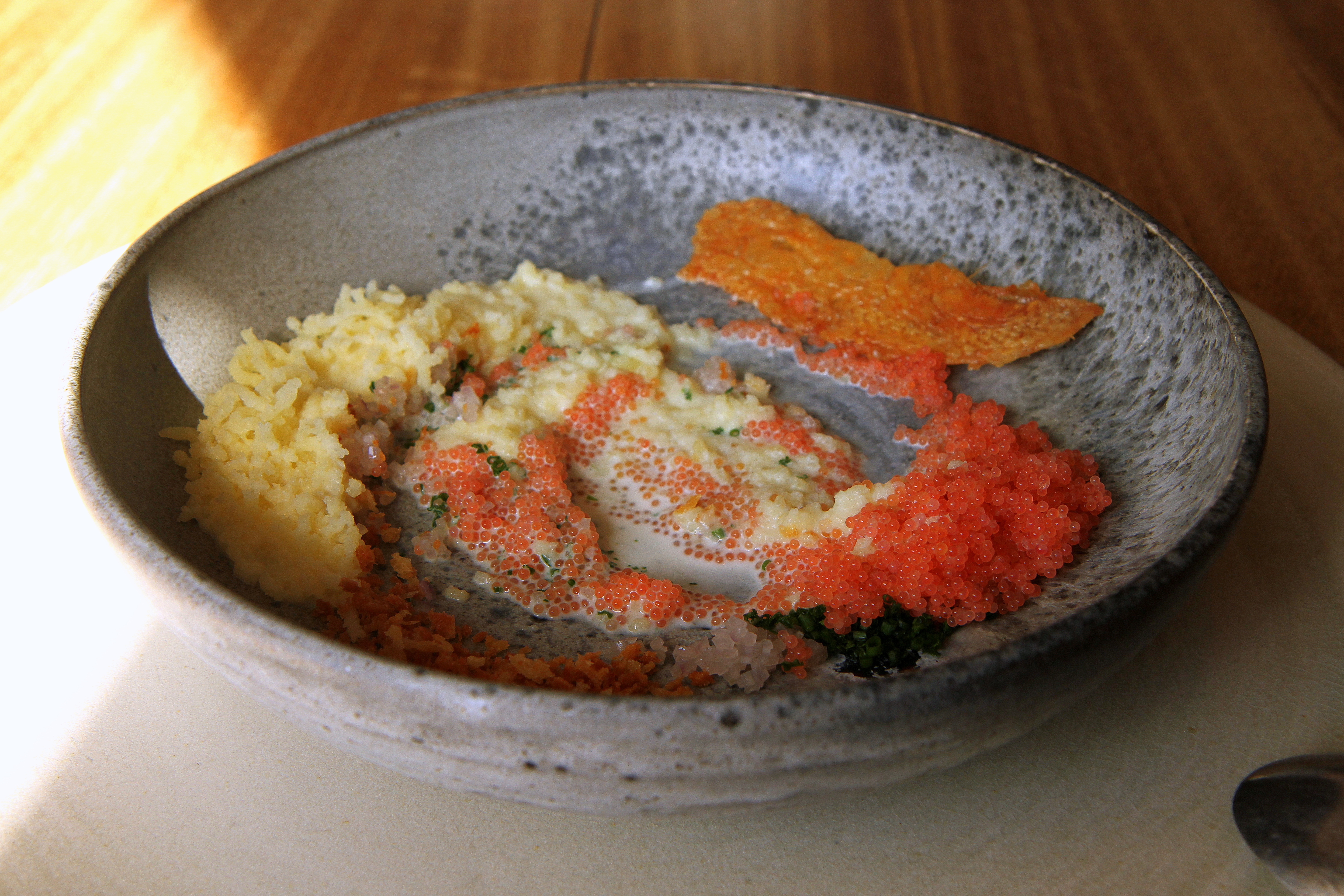
Plat Principal 2: Slow cooked farm egg; slow roasted farro, erbette chard, brown butter parmesan sauce. An egg, sous vide, surrounded by slow-cooked green farro, interspersed with erbette, arrived almost submerged in a parmesan beurre noisette whose colour corresponded precisely to that of the plate and aroma was delightful. The farro – an heirloom grain from which all others were derived – preparated similarly to risotto, were plump and nicely salted by the parmesan. Subtly bitter spinach beets soothed the richness of the creamy egg as the rosemary foam added a sweet accent to this satisfying dish.

Coi - Bellwether Farm Baby Lamb; English peas, spring onion, little gems, flowering thyme Coi - Bellwether Farm Baby Lamb; English peas, spring onion, little gems, flowering thyme 2

Plat Principal 3: Bellweather Farm baby lamb; English peas, spring onions, little gems, flowering thyme. Slow-roasted with mirepoix and thyme, the tenderloin and neck from a baby lamb, were served, each upon a slip of pea purée, drizzled with lamb jus vinaigrette and teamed with little gem lettuce, spring onions and more peas. The loin, layered with a little juicy fat atop, was succulent and toothsome, but the leaner cut of neck was unfortunately a tad dry and chewy. The vegetables were all well-cooked: the moist lettuce, crispy; sweet peas, crunchy; and the spring onion shells, firm to bite. Thyme-flavoured jus had a nice spicy twang to it.

Coi - Cheeses - Trio (Soyoung Scanlan); toast, spring lettuces

Cheeses: Trio (Soyoung Scanlan); toast, spring lettuces. A single wedge of trio – a triple blend of cow, goat and crème fraîche – from the Andante dairy, set on a thin wafer, was accompanied by baby local lettuce dressed with champagne vinaigrette. Trio is a creation of Soyong Scanlan, a musician/dairy scientist who has been growing her own cheeses since July 1999 and giving each a musical moniker; she uses Jersey cows’ milk from Spring Hill Dairy and goats’ from the Volpi Ranch. This example was dense with a pleasingly thick pate and fairly strong, though only hinting of goats’ milk. The fresh, barely bitter greens and slightly tart vinaigrette balanced well with it.

Coi - Pre-dessert - Pommelo Ice; coriander gel, cilantro

Pre-dessert: Pomelo ice; coriander gel. Segments of pomelo, superimposed by its grantité, were immersed in a gel of coriander. The meat of the fruit was juicy and sweet, whilst its ice was sugary and refreshingly cool; the spiced jelly struck a common citrus note with the pomelo.

Coi - Blood Orange Curd; douglas fir ice cream, black walnut crumble

Dessert 1: Blood orange curd; Douglas fir ice cream, black walnut crumble. A deep burgundy bar of blood orange, burrowed amidst black walnut crumble showered with powdered sugar and possibly confit orange supremes, was presented with a pastel pear-green coloured quenelle of Douglas fir ice cream and splashes of orange purée. The crunchy streusel, nutty with a hint of sweet-smokiness, was delicious whilst the smooth, fruity curd was just as good. Douglas fir ice cream, which had a welcome scent like wintergreen, was sugary, woody and slightly lemony-citrus, linking well with the orange, whose segments were like explosions of mellow juice.

Coi - Carmelized Jasmine Custard; hazelnut and cocoa textures

Dessert 2: Carmelized jasmine custard; hazelnut and cocoa textures. A firm custard log of jasmine, carpeted by crushed hazelnut and cocoa nibs and topped with sugar tuile was flanked by frothy splash of jasmine tea emulsion, decorated with jasmine leaf, and drop of gastrique. This syrupy caramel-sherry vinegar reduction was sour-sweet and had real kick. The custard itself was subtle and smoky, its velvet creaminess complemented by the brittle blend of nutty-cocoa nibs – essentially cocoa beans without their shells – that was milky and rich. The foam offered little except some lightly floral scent.

Coi - Petit Fours - Chocolate Ganache Truffle Coi - Petit Fours - McEvoy Olive Oil and Vanilla Milkshake

Petit Fours: Chocolate ganache truffle and McEvoy olive oil & vanilla milkshake. Brown sugar coated, brown butter truffle was thick, dark and had a touch of butterscotch. The vanilla milkshake, mizzled with mcEvoy olive oil was a treat; the shake’s cool, woody-sweet vanilla enlivened with a whiff of fruity-pepper from the Californian oil.

Coi - Menu 3

The staff were very professional, efficient and attentive. What I had at first considered as collectively aloof conduct, by the evening’s end, I appreciated as calm, quiet and actually peaceful comportments. Each server was friendly, considerate and engaging, making me feel at ease in an indeed serene setting. The chef, with whom I was able to exchange a few words with, surprised me. Having read some of the articles he has written, I admit I expected someone more assertive and, well, louder; instead Daniel Patterson was softly-spoken and quiescent – in fact, he was the personification of the mood his dining room had moved me to. Then again, he has mentioned before that he ‘normally hate[s], hate[s], hate[s] visiting the dining room…standing awkwardly in front of the table muttering inanities…’

The meal commenced with an interactive if, in my opinion, somewhat vain first few courses. The amuse and initial entrée, both intended to involve and interest multiple senses in a more explicit manner than the plates that proceeded, both had a rather limited effect on me. It was not that I found them gimmicky – after all, the association between savour and smell is well-documented – it is just that the methods by which this connection was made use of did not add to my eating pleasure. That being said, as the dishes continued, my enjoyment of them increased. The inverted Andante Dairy goat cheese and black olive tart was the earliest to excite, followed by the abalone/oyster and sweet, sour, salty, bitter – which I liked especially for its simple yet clever playfulness. The nettle-ricotta cannelloni was tasty, as was the sturgeon poached in smoked oil. The pairing of the fish and its roe, although almost intuitive, is used surprisingly sparingly, but Patterson applied it provocatively here. Blood orange curd; Douglas fir ice cream, black walnut crumble was the best of the desserts and possibly the most delicious dish of all. Dinner was not faultless though with the overcooking of the Bellweather Farm baby lamb the most serious disappointment, whilst the fried chicken consommé, though showing creativity, did relatively little for my palate.

When I consider the meal, I would say Patterson’s cuisine was, for the most part, very effective. The food was able to engage me – physically and mentally – through taste, texture and the natural aromas from the ingredients and their cooking. There also seemed to be a subtle pattern in the progression of plates, with the sensory focus shifting from initially olfactory, then textural to finally simple taste. The most capable course was actually one I felt rather indifferent towards. With the winter into spring, I found the flavours decent if not delicious, but I genuinely felt myself able to perceive the essence of winter and spring from the elements within the dish; here, I thought the chef’s use of contrasting temperatures and consistency, as well as his component selection, both intelligent and skilful. The abalone/oyster too, with its compelling oceanic theme, was not far behind in terms of efficacy. Attention deserves to be devoted to the chef’s excellent produce – I was actually stunned by the pure lemony sting of the wood sorrel that came with the sweet, sour, salty, bitter. I appreciate that California is blessed indeed when it comes to ingredients, but credit ought to go where credit is due. Actually, I can state with some confidence where each piece of produce today came from – I know, for example, that the black walnuts from my first dessert came from Full Belly in Guinda and that my English peas came Iacopi in Half Moon Bay. I know these because Patterson lists every supplier opposite his menu. This makes for interesting reading, but also impresses as it shows that all the chef’s ingredients are from local farms and growers, from Coi’s own garden or even foraged (like the seaweeds and alyssum flowers).

Judging on what I have read before and since this dinner, it appears that the cooking has become more consistent than it has previously been. Patterson’s skill as a chef or his sourcing has not been questioned, but meals have been criticised as lacking direction or a steady pattern. That was not evident today. Though I cannot nicely label Patterson’s style, neither can I say that dishes followed an incoherent or inconstant path. Instead, what was revealed from the start and remained the same going forwards was the use of prime products, ranging from common to educational, and their careful, but deceptively simple, preparation to produce a balanced and pleasing experience. For one thing, it must be said Patterson is no hypocrite – he is not interested in idly relying on his raw materials to do all the work, he is applying his own talent to making them better, making them more. 

What struck me most about this meal was my mood throughout and following it. It was one of extreme calm. The dining room, staff and the food all contributed to this emotion. The restaurant became almost my cocoon for that evening, sheltering my thoughts and myself from all but the plate in front of me.


373 Broadway, San Francisco
tel: 415 393-9000
nearest BART: Embarcardero
www.coirestaurant.com


Coi on Urbanspoon

l‘Arpège, Paris

l'Arpège

I heard a vicious rumour. At dinner recently, an American couple seated at an adjacent table, having engaged a friend and me in conversation, revealed that they used to eat at l’Arpège, but that was before the chef became a vegetarian.

It was a shocking comment. We were aghast.

In hindsight, however, such statements should not have surprised us; Alain Passard and l’Arpège are two of the least widely known and most misunderstood names in Paris. Furthermore, when either’s mention does elicit a glimmer of recognition it is either for the fact that l’Arpège is the city’s (and so a contender for the world’s) most expensive restaurant or verily for Passard’s vegetarianism. Both of which are incorrect.

It is important to address and redress the most misleading and most influential of these two assertions in more detail – the second. Passard is definitely not a vegetarian and, ironically enough, does not even like the term; he feels that the ‘real malady and unhappiness of vegetables has always been the vegetarian restaurant’. Instead, the chef is a patron and, indeed, prophet of la cuisine légumière.

In January 2001, Alain Passard made the headlines, having declared that ‘my menu will be entirely and exclusively dedicated to vegetables’. His decision was motivated mainly by personal choice, but in part by health concerns too (mad cow disease had reached France the previous year). The chef, having spent thirty years establishing himself as a maître rôtisseur, admitted that he ‘didn’t take any pleasure any more in eating meat’ and that ‘blood and animal flesh’ had stopped being a source of inspiration. The situation became so serious that Passard spent an entire year away from his kitchen, only setting foot in the restaurant to eat. ‘I no longer wanted to be in a daily relationship with the corpse of an animal. I had a moment when I took a roast out into the dining room and the reality struck me that every day I was struggling to have a creative relationship with a corpse, a dead animal. And I could feel inside me the weight and the sadness of the cuisine animale.’

Vegetables were his salvation. He needed new motivation and found it by replacing the raw materials with which he moiled, ‘like an artist who works in watercolours and turns his hand to oils or a sculptor in wood who changes to bronze’. The colours, flavours and perfumes of greens, herbs and flowers appealed to and stimulated him; more to the point, they changed his life. ‘All the terrible nervousness and bad temper that are so much part of the burden of being a chef were gone with the old cooking. I entered into a new relation to my art, but also to my life. And the lightness of what I was doing began to enter my body and my entire existence and it entered into the existence of the kitchen. It was like a light that I saw and a door that I walked through’.

Passard recognised this new vegetable-focused cooking as his ‘renaissance as a chef’ and, to return the favour, he wanted to dedicate himself and his skills to their elevation. However, his consequent, aforesaid abandonment of red meat and its replacement with green veg, was met with scepticism and cynicism: ‘you are offending your colleagues who are still cooking meat’, claimed a caller during a radio interview; ‘is this not an act of blatant opportunism at a time when French farmers and butchers are suffering?’, demanded reporters; contemporaries feared for him; Paul Bocuse professed he was uncertain how Passard would fare, but conceded that ‘perhaps he [could] succeed – that boy certainly has a lot of talent’. Michelin suggested that it was a courageous strategy while he himself realised, ‘I am putting all the cards on the table. Putting myself and my entire career in question. My three stars, the public, my clients’.

Not one for half-measures or hollow gestures, having staked his livelihood on légumes, he dedicated his leisure to them too. In 2002, he bought the Château du Gros Chesnay, in Fillé-sur-Sarthe, about two-hundred kilometres from Paris, near Le Mans, sharing the property with the previous owner, Madame Baccarach, who minds the house whilst the chef visits the two hectare garden each weekend, employing three gardeners to tend to it fulltime. Using only natural fertilisers, non-mechanical tools (like horse-drawn ploughs), a rotating small-plot system and pesticides made exclusively of vegetable extracts, this organic potager is a ‘showpiece of permaculture’; there is even a purpose-built lake on the grounds and four bee-hives to help maintain a balanced ecosystem (and provide l’Arpège with its very own honey). In his pursuit of grand cru greens, Passard is in constant contact with horticulturists, farmers and gardeners whilst also reviving heirloom varieties of various vegetables (including thirteen sorts of asparagus). The garden contains one-hundred-and-fifty different breeds of plant and supplies eight to ten tons of produce per year – nearly all that the restaurant requires. The crops can be picked at seven in the morning, in time for the ten o’clock TGV to Paris; no refrigeration is necessary and transport times are short – therefore the légumes lose very little of their freshness and flavour – and thus, that morning’s bounty is able to become that afternoon’s lunch. What l’Arpège does not consume is sold on a small counter at la Grande Épicerie du Bon Marché and any kitchen waste is returned to the garden for use as compost. The project’s success has led to the addition of two new farms at Buis sur Darnville and at Baie du Mont-Saint-Michel; the chef can now call on a team of twelve farmers to cultivate a sum of six hectares. His mission, he says, is to encourage people ‘to talk about the carrot the way a sommelier talks about Chardonnay’.

As alluded to earlier, Passard’s repute was primarily built upon a talent for roasting meat and poultry. This he learnt from Louise Passard, his grandmother and also his teacher. It was through her that he developed not only an understanding of how to cook – and form a relationship with the flame – but also how to host and prepare a meal: ‘they’re all her recipes. She gave me everything, taught me what to look for when I made my first purchases, taught me the right cooking times and temperatures.’ Around the hearth, they spoke of the fire and its ability to sculpt the product; the importance of watching and listening to it; and the sensitivity of a cook.

His parents, a musician and dressmaker, lived in La Guerche, Brittany, and their neighbour, the village’s pastry chef, was Passard’s second inspiration. At the tender age of ten, he began to train with him, discovering the ‘rhythm and activity of the laboratory and the evocative qualities of aromas’. At fourteen, he became an apprentice cook at Hotel du Lion d’Or, Liffré under Breton star, Michel Kéréver, learning la cuisine classique and the appreciation of good products. Four years later, he moved to la Chaumière, Reims to work with Gaston Boyer, furthering his classical education whilst studying the art of seasoning and cooking. In 1977, he joined Alain Senderens’ l’Archestrate and enjoyed the most instrumental period of his career. Under Senderens, ‘a perfectionist in constant search of originality’, he discovered his creativity and the power of imagination; it was a ‘baptism of fire’ cooking in a small kitchen, but with a tight team and exceptional atmosphere. Here, he expanded his repertoire of and improved his touch with spices (and possibly picked up his cigar habit too). After three years, he took the reins at le Duc d’Enghien in the northern Parisian suburb of Enghien-les-Bains. Within two years, he had earned two Michelin stars and, not yet twenty-six, became the youngest chef to have ever achieved such a feat. It was during the four years spent at this restaurant that he conceived some of his classics including carpaccio de langoustines and le chaud-froid d’œuf à la ciboulette (the possible precursor to the infamous l’Arpège egg). The next two years saw the chef at le Carlton, Brussels, were he was once more awarded a first and second star successively in that short time. It was not until October 1986, however, that Passard was able to proclaim, ‘je suis chez moi’. Senderens had moved to Lucas Carton and Passard had moved into his mentor’s old home, l’Archestrate. By March of 1998, history repeated itself, a second time, and the newly-named l’Arpège had been visited twice by Michelin within two years; although the chef had to wait eight more, until 1996, to finally win his elusive third star.

For the last twenty years, Passard has devoted his time and efforts to l’Arpège and its success, limiting himself to just a select number of outside business interests that include co-producing moutarde d’Orléans with Jean-François Martin, collaborating with Chrisofle on a line of vegetable-orientated crockery, selling the restaurant’s bread recipe to bakers and writing, with Antoon Krings, a children’s cookbook, « Les Recettes des Drôles de Petites Bêtes ». He also participated in Japan’s Iron Chef competition between 1997 and 1999, where he won considerable acclaim.

Alain Passard’s unique combination of controversy and accomplishment even prompted French business school, INSEAD, to conduct a case study with him as its subject. ‘[He] is a fascinating example of someone who has succeeded by being both highly creative and very efficient in management terms. Much of what [he] has done breaks the rules,’ revealed one professor. The analysis showed that although small in size, located in the ‘culinary desert’ of the 7e, refusing to offer valet parking, eschewing celebrity status and playing down branding, he has not only disproved detractors that expected him to lose his third star, but prospered, created his own supply chain and set himself up as a paradigm for peers.

The l’Arpège appellation immediately lets slip plenty about Passard. The chef chose it above all as a tribute to his musician father (arpège being French for arpeggio), but whilst also bearing in mind that selecting a name beginning with A would cunningly allow him to keep the former resident’s monogrammed crockery.

l'Arpège - la Salle l'Arpège - la Table

The restaurant itself resides near the prime minister’s offices and government ministries, on a quiet street, opposite the Musée Rodin. Without, it is non-descript and unadorned save some flowery script that spells out l’Arpège, but within, the dining room is warm and comfortable. Rich browns and earthy oranges dominate; pear wood panels line the interior; and a dog-eared, burgundy carpet covers the floor. Music is Passard’s second love and the melodious insinuation suggested in the restaurant’s title is maintained by the motif inside: handmade Lalique pâtes de verre, inspired by the carriages of the Orient Express and inset along the far wall, depict Pan playing the flute whilst frolicking with two naked nymphs (images mimicked on menu covers); an abstract split cello sculpture by Arman sits in one corner; a coarsely-carved wooden guitar grows out the serving station; and, upon Bernard Pictet windows, etched waves ripple. This undulating design is also incorporated into Jean-Christophe Plantrou’s peau de poirier panelling and Massacar ebony furniture pieces. Rich, red leather upholstered chrome seats and chariots as well as the various bucolic bibelots such as large desiccated gourds or little twig bundles that rest upon tables, play on art déco principles. The only presence on the room’s walls is the nineteen-thirties/forties portrait of Louise Passard, which watches over the ‘chef’s chair’. White linen tabletops are dressed with bright red cover plates, Bernaudaud crockery, Christofle cutlery and customised glassware inscribed ‘Fabrique pour Alain Passard’.

l'Arpège - ALC l'Arpège - Menu 'Arpège de truffe' l'Arpège - Menu 'l'Hiver des jardins'

This was my third visit to the restaurant and, as I had not ordered from, let alone held, the l’Arpège menu on the previous two, I decided not to break what was fast becoming a rewarding habit. My second time here had only been two weeks ago, when Aaron, his brother and I had enjoyed an excellent meal (highlights included damier de radis pastèque et coquilles Saint-Jacques d’Erquy; huile de noisette and couteau avec poireau, échalote et ail), so Hélène Cousin, maîtresse d’hôtel, was already aware of my preferences and offered that the chef arrange something. For the record, none of the dishes from the previous occasion, besides the signature egg and one other, were repeated.

l'Arpège - Amuse Bouche 1- les Tartelettes: Mousseline de betterave et vinaigre balsamique; et mousseline de poire avec carotte jaune et praliné de noisette 2

Amuse Bouche 1: les Tartelettes – Mousseline de betterave et vinaigre balsamique; et mousseline de poire avec carotte jaune et praliné de noisette. To tease the taste buds, a quartet of tartlets in two varieties arrived. Two pastry cup couples, symmetrically similar but constructed with contrasting components, carried the classic pairing of beetroot and balsamic vinegar and the less common one of pear, carrot and hazelnut. The former, formed with a mound of beet mousseline mounted by a smaller disc of albina vereduna (white beetroot) topped with a drop of balsamic, was sugary and earthy with a touch of sharpness. The latter, with pear mousse, yellow carrot chip and hazelnut nugget, was sweet, herby and nutty.

l'Arpège - le Pain et Beurre

Le Pain et Beurre: Pain de campagne; le Beurre Bordier. Excellent, thick slices of slightly warm, slightly sour, homemade country bread, with an open crumb, had rustic crunch, soft, fluffy centre and nice seasoning. As toothsome as this was though, the beurre de baratte – from Jean-Yves Bordier of St. Malo – was simply terrific, actually it is the best butter I have ever had. Sculpted into a semi-circle and standing on one side (Bordier has a customised shape for each restaurant he supplies), it was creamy, spreadable and saturated with sel de Guérande, the hand-harvested sea salt considered the finest in the world. This butter is addictive.

l'Arpège - Amuse Bouche 2: Oeuf à la coque; quatre épices l'Arpège - Amuse Bouche 2: Oeuf à la coque; quatre épices 2

Amuse Bouche 2: Oeuf à la coque; quatre épices. An egg from the ferme de Bigottière in the eponymous little village of the Loire, diligently decapitated and its white drained off to leave only the unbroken yolk within its shell, was simmered in a water bath until just before the yellow could set; it was then sprinkled with chives and quatre épices prior to the addition of a little crème fraîche with aged Jerez vinegar, smidgen of Canadian maple syrup and fleur de sel to finish. There was a deft drama here; the first, ginger, shallow spoonful was sour and pungent owing to the fresh cream and spices, but once one had summed up the courage to plunge down into the egg fully, bursting the yellow and allowing it to blend with and bind all the elements altogether, the taste was transformed. The warm, runny yolk itself was intense, but balanced by the whipped cream, light and barely bitter, with aid of the sherry vinegar’s acidity, whilst together, the two soothed the syrup’s deep, smoky sweetness as the four spices – clove, nutmeg, white pepper and ginger – added aroma and exaggerated the flavours already there with their own sharp, bittersweet woodiness.

This signature, humbly presented in an elegant, but basic, silver egg-holder sat upon two plain, porcelain plates, a smaller superimposed upon a larger and each unadorned except for a thin, red rim, is an archetypal amuse: it has harmonious yet exciting savour; simplicity and complexity; contrasts and variation in texture and taste; the demonstration of technique, humour and creativity; an arresting dynamism; as well as of course quality ingredients. More to the point, it awoke and provoked the palate.

l'Arpège - Bouquet de turbot de Bretagne au miel du jardin « récolte été 2008 »; vinaigre de Xérès l'Arpège - Bouquet de turbot de Bretagne au miel du jardin « récolte été 2008 »; vinaigre de Xérès 2

Entrée 1: Bouquet de turbot de Bretagne au miel du jardin « récolte été 2008 »; vinaigre de Xérès. Bréton turbot, grilled then cooled and swimming in a sticky sauce of honey infused with peanut oil and lime, had been blanketed with four wafer-thin, cross-sections of black radish, then freshly peppered at the table with more of the sauce making a bucolic boundary around the bouquet. The initial taste of the honey, harvested the previous summer in Passard’s own organic garden, was delicious – strong, sweet, zingy, tart and nearly nutty, this was a heady and complex combination. The firm slices of radish, still crisp, offered a hint of heat and textural distinction. Moist yet firm turbot had great flavour, its delicate marine sweetness complimented and countered simultaneously by the aigre-doux sauce, whose nicely viscous nature meant it coated each meaty morsel pleasingly. Pepper provided another individual accent.

l'Arpège - Parmentier des légumes du jardinier

Entrée 2: Parmentier des légumes du jardinier. Presented in matching manner to the Arpège egg – starkly but assuredly in an alabaster ramekin atop two concentric plates – a potted pie came with an enticingly crumbly, rusty gamboge crust of semolina and crushed black pepper. The cuillère, penetrating its cover, uncovered a thick, pale gold vegetable purée composed of parsnip, beetroot and radish; further excavation exposed a narrower, darker foundation of confit chestnut and oignon doux de cévennes. Airy, light and earthy-sweet, the upper layer was like whipped cream. Beneath this, the melted down chestnut and sweet cévennes onions, were much sweeter and had a stringy yet more unctuous consistency. This was clearly a witty makeover of traditional hachis parmentier or shepherd’s pie – basically, mashed potato over minced meat and onions – but missing the meat.

l'Arpège - Gnocchis multicolores; quaternaire au beurre noisette l'Arpège - Gnocchis multicolores; quaternaire au beurre noisette 2

Entrée 3: Gnocchis multicolores; quaternaire au beurre noisette. A quaternary of colourful, chubby gnocchi of beetroot, smoked parsnip and parsnip pair, were presented resting in Bordier beurre noisette and garnished with Parmigiano-Reggiano and sage. A lovely, herby odour emanated from the dish. The beetroot pasta was like a thick pâté of well-balanced sugary-earthiness. The parsnip trio was lighter and grainer, each dissolving on the tongue. The smoked example was just that while the plain parsnip twosome had delicate vegetal-sugariness. The butter sauce was obviously delicious; parmesan had a touch of sharpness and depth; and musky sage, a faint spiciness.

l'Arpège - Huître poché; truffe noire de Périgord et cerfeuil l'Arpège - Huître poché; truffe noire de Périgord et cerfeuil - ouvert

Entrée 4: Cerfeuil à l’huître de l’archipel de Chausey; truffe noire de Périgord. A single shelled oyster Marenne d’Oléron, in almost alternating shades of grey and copper, came casually bound with bow-tied string and sitting on a dune of coarse sel de Guérande. Visual senses surfeit, the loop was loosened and lid lifted to disclose an oyster that had been shucked, replaced and then poached in olive oil, before being dressed with a slice of black truffle and sprigs of lacy chervil. A fresh whiff of the sea immediately impressed. The sizeable and succulent shellfish’s savour was sweet and salty with clean, short linger; it also had a faint nutty note that was in quiet concord with the fainter truffle whilst the chervil added herby freshness.

l'Arpège - Sushi légumiers à la moutarde d’Orléans oncteuse; turbot de Bretagne et d’écrevisses l'Arpège - Sushi légumiers à la moutarde d’Orléans oncteuse; turbot de Bretagne et d’écrevisses 2

Entrée 5: Sushi légumiers à la moutarde d’Orléans oncteuse; turbot de Bretagne et d’écrevisses. Resting amidst marjoram leaves, its long stems and dainty drizzles of olive oil and balsamic vinegar, two rice-paper-wrapped packages of cauliflower, black radish and regular radish julienne, seasoned with a midge of Orléans mustard, were crowned with turbot and crayfish respectively. Each bundle boasted crunchy, peppery, earthy vegetables gently spiced. Both specimens had distinct, fine flavour; the mustard coming through especially with the turbot piece. Vinegar livened up the plate with its sugary acidity as did the marjoram’s subtle citrus. The savours were pure and delicious, light and refreshing.

l'Arpège - Fines ravioles potagères; consommé végétal

Entrée 6: Fines ravioles potagères; consommé végétal. Next it was a quintet of ravioles, each with a wrinkled skin wrapping various finely-diced vegetable fillings, floating in a translucent, saffron-shaded consommé of celery root. The soup within which these wonton-like parcels were submerged was refreshing, precise and pure. Ravioles, common to the Drôme and Isère, were created when Italian loggers from Piémont, adapting their traditional meat-filled ravioli to their new, more limited means, crafted smaller pastas from turnip sheets that they stuffed with vegetables or fresh cheese. Now customarily eaten at Easter, when meat is forbidden, Passard applies an Eastern twist to the dish, serving them in a clear vegetal broth. All had thin, almost see-through casings that melted in the mouth. The rendering of black radish with horseradish had mustardy, sweet heat; chestnut, crumby, sweet earthiness; the celery was light and crunchy; endive, perky; and cabbage, crisp and mild.

l'Arpège - Tagliatelles de céleri-rave et risotto à la truffe noire; herbes fines

Entrée 7: Tagliatelles de céleri-rave et risotto à la truffe noire; herbes fines. Filigree-like, thick threads of counterfeit tagliatelle, actually composed of celeriac, were surrounded by a shallow emulsion of moutarde d’Orléans and stippled with parmesan and fines herbes. For the first time today, I was served something I had already tried the previous week, so I decided to tease Hélène about it, pointing out to her this was a repeated dish and, not only that, but before it had come with black truffle. She took it in good humour, but returned moments later. Not empty handed. A bowl of parmesan risotto replete with truffle was set besides my plate of pretend pasta.

l'Arpège - Tagliatelles de céleri-rave à la truffe noire; herbes fines l'Arpège - Tagliatelles de céleri-rave à la truffe noire; herbes fines 2

Al dente root ribbons yielded subtly to bite, but still had satisfying crunch; their gentle nuttiness hit a note with the strong parmesan. The Orléans mustard sauce was frothy yet forthright with agreeable spiciness. This condiment is manufactured from a medieval recipe, which Passard and Jean-François Martin, an Orléans vinegar-maker, have saved from disappearance. It consists of mustard seed, sel de Guérande, Martin-Pouret vinegar, honey and Chadonnay and is made by traditional, machine-less methods.

l'Arpège - Risotto à la truffe noire; herbes fines

The risotto was reminiscent of savoury rice pudding; it was extremely creamy with a very slight sweetness. The truffle, with its full fungal fragrance and effect, was in harmony with the rich hazelnut and olive oil dressing whilst the ivory Arborio grains melted away immediately upon ingestion.

l'Arpège - Betterave en croûte de sel gris de Guérande; vinaigre balsamique

Entrée 8: Betterave en croûte de sel gris de Guérande; vinaigre balsamique. From a whole golden beetroot – albina vereduna – that had been baked in a crust of sel de Guérande, broken out then carved, a solitary quarter was dished upon a dribble of twelve-year old balsamic vinegar. This was so simple and superbly subtle yet so confident and utterly emphatic. The supple centre of the succulent, sweet beet had been coarsely, though consummately, cut from its saltier, earthier skin, within which it was now cradled. The conflicting intrinsic character of the ingredient itself, the silky lustre of its soft flesh in stark comparison to its rough, harsh rind, was masterfully manipulated. Such internecine distinction was sharpened and cultivated with the addition of the acidic, fruity sweet, aged vinegar that loitered on the tongue.

l'Arpège - Côte de porc en croûte de sel gris de Guérande

I cursed my luck in between this course and the next as the day’s ‘special’ was wheeled out and showed off to the crowded room. There was seated, on a shiny silver chariot and atop a considerable silver serving platter, côte de porc in sea salt crust with its coral-like crackling glistening. An entire rack of pork, none of which I could have….

Shortly after the pig’s pageant, Passard sneaked out the kitchen. Dressed in customary colourful neckerchief and denim jeans under his chef’s whites, he greeted his guests.

l'Arpège - Brioche de légumes à la moutarde d’Orléans onctueuse; ouef de caille

Entrée 9: Brioche de légumes à la moutarde d’Orléans onctueuse; ouef de caille. Toasted, buttered brioche bearing a plump, terra cotta coloured patty of chopped legumes – beetroot, radish and turnip – was topped with parmesan and finished with fried quail egg; alongside lay a careful squirt of beetroot mousse. The warmth of the vegetables had begun melting the cheese whilst the egg, as if its yolk were pricked on purpose just before presentation, started to dribble over this cheeky, bogus burger to which the beet purée played the ketchup. The melange of veg had a pasty, thick texture and peppery, savoury relish. The unctuous, toothsome quail egg, creamier than that of hen, was cut through by the light but tartly-sweet beetroot.

l'Arpège - Coquilles Saint-Jacques d’Erquy à l’unilatérale; chou et thé vert « Ashikubo Sencha »

Plat Principal: Coquilles Saint-Jacques d’Erquy à l’unilatérale; chou et thé vert « Ashikubo Sencha ». Prepared à la plancha, a pair of scallops from Brittany, still attached to their shells, were interlaid with draping leaves of cabbage, steeped in Ashikubo Sencha, and thin cross-sections of shinrimei; the chou’s matcha sauce was also mizzled over the shellfish. This was a feast for the eyes and I allowed mine to enjoy it: shellfish and cabbage in matching shades of creamy white, and radishes, with starburst magenta middles and dark emerald edges, all smeared with a gentle green that collected in pastel puddles around each Saint-Jacques, in the shallow impression of their particular shuck, which themselves, both alabaster at large, were adumbrated mahogany before burnt umber towards their tips. Erquy scallops, arguably the finest France has to offer, were fat and well-flavoured, but I admit I would have preferred them a touch less done, although they were evenly cooked and still dissembled willingly in the mouth. Excellent cabbage that had bite to it was coated in thick tea that nicely and fully infused the leaves; the attractive radish, an heirloom variety of daikon, was mildly sweet with a pinch of pepperiness. The sauce of premium sencha, dried in the traditional way with wood fire, was complex and interesting. It was distinct and definite, but muted with a very mellow, woody astringency, faint vegetal-grassiness and subtle bittersweetness. Its consistency – fluid yet with a dense, almost starchy aftertaste – also intrigued.

l'Arpège - le Fromage l'Arpège - Le Fromage - Comté de Garde Exceptionnelle september 2004; Bernard Antony

Le Fromage: Comté de Garde Exceptionnelle september 2004; Bernard Antony. Alsatian maître affineur, Bernard Anthony’s famous four-year old comté, freshly shaved from the huge muele that is wheeled about the room on its own petrified wood tray and chariot, was a must. This is, in my opinion, the world’s greatest cheese. Anthony, first discovered by Alain Ducasse, started aging cheeses in 1982, after meeting Paris’ most eminent affineur of the day, Pierre Androuët who encouraged him to set up his own cave in Vieux-Ferrette. Today he has four and simply refuses to purvey his wares to anyone but the best; this comté is his masterpiece. Intensely yellow, aromatic wafers come riddled with crystals that effervesce with concentrated cheese essence. Creamy yet dry, they evaporate on the tongue, exploding with strong flavour that lingers long on the palate. I have never found anything quite like it. Delicious.

l'Arpège - Millefeuille « caprice d’enfant » l'Arpège - Millefeuille « caprice d’enfant » 2

Dessert 1: Millefeuille « caprice d’enfant ». A capricious construct, composed of thick, thin, then thick again, rusty tiers of pâte feuilletée caramélisée, each punctuated by bold, brimming billows of crème pâtissière noisette, came crowned with a final few sheets of pastry powdered with icing sugar. Served without any accompaniment, naked in the centre of an empty plate, this dessert exuded confidence; impressing with both its munificent measure and its complete physical dominance of the dish. Incredibly crispy, light and flaky, each bite broke the pastry into a thousand tasty fragments. The subtle, creamy mousse, like praline chantilly, was rich without being heavy. Each mouthful of millefeuille overwhelmed with a wealth of textures and sweet, nutty savours.

At this point, Hélène wandered over once more, ‘so, how is it going? Have you enjoyed your meal?’ Stretched out and slouching in my chair, my Cheshire cat grin was sufficient affirmation for her. ‘If there is any room,’ she began, but I had already sat up and started nodding, ‘mais bien sûr!’ ‘In that case, I think there is something in the kitchen…’ She was out of sight for but briefly, before returning with the following.

l'Arpège - Île flottante moka-mélisse; caramel au lait l'Arpège - Île flottante moka-mélisse; caramel au lait 2

Dessert 2: Île flottante moka-mélisse; caramel au lait. A stout yet shapely couple of coffee sorbet quenelles, buoyant on bright yellow lemon balm crème anglaise, were laced with lashings of caramel syrup. The sorbet, which were substituted for customary meringue in this île flottante, had the most interesting texture; ice cold, astonishingly airy, ready to dissolve in the warmth of the mouth and with an almost fizzy vibrancy. The roasted smokiness of the coffee was distinct, but the strength, well-judged; lemon balm custard bath had an exotic sweet spiciness that teased the palate; whilst the caramel au lait had a light, honeyed richness.

l'Arpège - Petit Fours et Café

Petit Fours: Sucerie; 3 macarons du jardin. Presented upon a small linen-layered sterling tray, petit fours comprised palmiers à la badiane, nougats aux betteraves, petite tartes aux pommes and macarons of beetroot, coffee-parsnip and apple. Heart-shaped, baked puff pastry were crunchy, grainy and tasted of dark, sugary liquorice. Surprisingly nice beet nougat had very strong, even earthy, nuttiness. The assortment of macarons were good; apple had big, saccharine acidity; beetroot was clear, complex and full-flavoured; and coffee-parsnip had vegetal sweetness and mild, maybe too much so, mocha essence.

l'Arpège - l'Addition

In my experience, which has been solely under Hélène Cousin’s stewardship, the service here has always been superb. As maîtresse d’hôtel, she is charming and welcoming, engaging and obliging. In addition, it is evident that she is an effective and efficient task-master, running a proficient, professional and tight team that seem always on the move, but always there when needed. Nadia, her able lieutenant, is persistently more helpful and knowledgable than expected whilst showing a touching recollection for one’s likes/dislikes. Friendly, well-informed and genuinely considerate, Sylvestre and Dav, who also looked after me, were also excellent. It might be argued that the fact that the front-of-house is directed by a feminine hand means that there is a grace and consideration to service that escapes some more macho establishments. Another attribute of l’Arpège’s staff that I find especially endearing is their generosity; the diner’s pleasure is of paramount concern with meals more often that not customised to suit palate and pocket. One can also sense a mutual pride amongst them for their chef’s creations, patent by the wish that the guest shares this fondness and embodied by efforts to that end.

Today’s meal was creative, satisfying and delicious. Each course pleased and teased, from the customary tarts, egg and brilliant bread and butter through to desserts. Bouquet de turbot tantalised the taste buds; the parmentier was as indulgent a vegetable dish as I could imagine; whilst the gnocchi were very good. The poached oyster and the sushi were a sight to behold and received with tremendous excitement, but the fact that the coquilles Saint-Jacques were cooked a little more than I prefer is the only detail that prevents me declaring this experience as technically faultless. l’Arpège’s comté is quite simply the greatest cheese I have ever had while the millefeuille was a very tasty treat and very messy fun to eat.

I must confess Passard’s cooking leaves an immensely moving impression on me; I struggle to name another chef – except possibly Bernaud Pacaud, albeit in an utterly different, almost opposite manner – whose food I find even as emotive as his. It is, as it is with all things sentimental, difficult to qualify and even more to articulate how or why. But I will naively try.

The food appeals to all and every sense.

First, there is the visual and at l’Arpège there is a raw aesthetic I have never seen matched. The chef’s artistic esprit is expressed acutely through impeccable elements, minimalist in number maybe, but full in colour and vitality. Passard believe in the single perfect gesture and this faith has great effect. Presented upon red-rimmed, bright white plates, golden yellows, pastel greens, vivid oranges and rich burgundies dot, splash or pepper a blank canvas, always leaving exposed some immaculate ivory, with which, the contents’ chromatic contrast creates a stark and bold reaction. There is almost an austerity and gravitas in this distinction and juxtaposition between dish and food – white against colour, empty against filled, crockery against contents – that has the potential to shock as much as it does intrigue and excite the diner and their fantasy.

There have been several moments when I have been left at a loss for words by the very serving and sight of a course. From my first meal, it was the epinards palco fanés au beurre noisette; carotte à l’orange. To some this dish of just a few strands of spinach, quenelle of carrot mousseline and smidge of lemon confit would have been enough to warrant complaint and criticism for its superficial simplicity, but it arrested my attention from first bite to last and left me speechless, or at least refusing to speak. Today, it was the huître poché; truffe noire de Périgord et cerfeuil, followed in swift succession by the sushi légumiers à la moutarde d’Orléans oncteuse. Both were unpredicted – never having received nor even seen or read of oysters in any form and anything so essentially exotic being served here before – and both were stunning. The former, a single unadulterated shell, stringed together, sitting on a small stack of sea salt in imitation of its native ecology, almost brutally beautiful in its pure and primitive, streaked shades of white, grey, blue and brown; whilst the latter, like a plate of little creatures, alive and crawling through sylvan-esque leaves, stirred me with avidity and interest.

Secondly, it is one’s imagination and intellect that are satiated. This aim is achieved with the use of humour, boldness, wit, suspense and surprise. To start with the last of these tools first, on a fundamental level and a personal one, remembering that I have always favoured letting the house serve me what it wishes, my overall enjoyment has been heightened by not knowing what dish or in fact how many dishes will come.

Then there is Passard’s panache and flair, his creative and culinary genius to contend with. This is most keenly felt via his valuable vegetables. The meat main course as the culinary climax to a meal is a custom few chefs refuse to follow. Here, however, regular viande rouge is not an option, but though this may be the case, no red meat is no loss and its presence is never missed. Instead, the chef capitalises on diners’ acculturation to or expectations of a meaty acme with the at times subtle, sometimes startling, but always effective substitution of vegetables for flesh. Examples of this abound from today alone. The brioche de légumes was its most blatant display, but there was the parmentier as well, which although traditionally made with beef, was improved here with mixed roots. Consider the infamous betterave en croûte too; arriving buried and baked within a firm saline skin, like a rack of lamb has for centuries been, as the salty crust is broken open, a single, basic beet manifests itself in mild mockery of its muscly predecessor. Then, as the meal nears its end, a sharp Laguiole– the generic haute gastronomic gesture that the meat is coming – is set down, but instead, the diner’s brainwashing becomes the butt of toothsome tomfoolery and the finest cheese or a surprisingly classic dessert appears. The fun does not stop there. Merely eliminating meat from the menu or showing flesh to be frivolous is not sufficient; Passard seeks to prove that vegetables can be great and, to do this, he strives to show that they can also be enough. Thus, after remaking such meaty recipes, he turns to carbohydrates, revealing rice and pasta as passé: celeriac is cut into thick strands of tagliatelle; risottos are replicated with grains of graven radish; and potato (technically still a starch, but in the ground at least) is reproduced as thin, loose strings of spaghetti.

Thirdly – and bear in mind, one has not even had a taste yet – it is one’s sense of smell that is seduced. With produce of such superior standard and piping hot plates, served by serveurs/serveuses holding napkins to protect their hands – in a manner that invokes the home – the aroma of each course is clear, distinct and mouth-watering. The heat encourages these natural, warming odours whilst the frequent feature of flowers, herbs and spices simply strengthen the effect.

Fourthly and finally, one samples the savours. Fashioned from the freshest and finest gifts that the season offers, flavours are clean, precise and honest, but above all, appetising. Passard is a master of texture and contrast, championing and challenging his ingredients each to accomplish what some chefs might select several to do. Where others require four, five or more different products to vary taste, consistency or add a dynamic aspect, Passard needs just a single or maybe couple of components. Alliums, for example, he uses expertly, exploiting their intrinsic layers to change each mouthful, renewing the eater’s curiosity with each new bite. He serves the first asparagus of the season with citronelle, taking advantage of the inherent sweet and bitter variance within the very vegetable, magnifying both sides of the flavour spectrum with the complimentary and conflicting tastes of caramelised garlic and lemongrass, thus amplifying what nature already provides and making a plate laden with only a couple of spears of asparagus worthy of a three-star dining room.

Additional favoured arms in the l’Arpège arsenal include vin jaune, oak-smoking, moutarde d’Orléans and aigre-doux – using elements such as honey, lime, lemon, pine nut oil, soy and balsamic vinegar separately or often together – to liven sauces, introduce some spice and stimulate the palate with their complex savours.

For the last twenty years, the chef has followed those first examples set forth by his grandmother, using his eyes and his ears, listening to the flame and slowly, gently cooking – ‘il faut aussi apprendre à maîtriser le feu afin qu’il n’agresse jamais mais plutôt qu’il caresse’. Steaming, frying in a wok and even using ovens are outlawed in his kitchen for ‘being far too aggressive…ruining colour and perfume…and drying everything out’ respectively. Here, the temperature of the pan is capped at 100ºC; poultry is cooked on the stove over the lowest possible heat in almost no liquid (except for some salted Bordier butter), turned by hand, the skin never broken, for a couple of hours; and chefs grill in salamanders set at eye level, where the heat is easier to control. These meticulous methods really do yield special results – it was during my initial time at chez Passard that I tasted the turbot and lobster that are both now the benchmarks by which all other renditions of those two ingredients are judged.

Passard promotes the relationship between chef and ingredient, which he feels has been lost through the modern use of gas and electric cookers, and urges his staff to use all their senses whilst at the stove – ‘it becomes a meditation and the kitchen, a place of listening’. As he regards cooking to be the work of the ear, he so considers it, by extension, a cousin to music. Thus, taking into account that he himself is a saxophonist and lover of jazz (in particular John Coltrane), any sort of discussion about l’Arpège is impossible without any mention of music as well as art, which together are inseparable from and underpin the restaurant’s philosophy and both of which are personified by the man, the cuisine and even by the dining room.

Passard’s own style clearly shares characteristics in common with his favourite musical form; both are creative, expressive and innovative. Whilst traditional chefs were still singing the blues, he was making it up as he went along, improvising on the off-beat – others focused on the flesh, whereas he played with forgotten vegetables. As his cooking can be symbolised by syncopation, so can his restaurant by a polyrhythm. The front-of-house and kitchen, each almost independent, marching to the beat of two bands, come together to form a harmonious whole. And the musical analogy is easily extendable with Passard playing the ‘composer’; his ingredients the ‘instruments’; flavours, textures and scents his ‘quavers, crotchets, minims and semibreves’; and so on.

From the décor further inferences may be made by the open-minded and interested eater, explicitly that the essence of l’Arpège and the very animus of the chef are encapsulated and expounded within the length and breadth of the building. Melody and the garden, Passard’s other passions, again come to the fore: a guitar grows out the pear wood; Greek figures dance and make music on the walls; the menu is laced with musical iconography; and the very name that sits above the door sings volumes. More subtly or subliminally, the space is constructed from curves, circles and rounded edges in subconscious reflection of an artist’s open and free spirit, famously opposed to strict rules and parameters, and thus, straight lines and definite edges. Then there is Passard’s affection for his crops and the countryside, which has brought the garden quietly into his home: the walls, wrapped in wavy wooden boards, imitate the trees or maybe fence that invariably borders the jardin; a mural, like those more commonly found outdoors, is painted between the two windows that look out upon the street and shows the chef carrying his produce in his hands; atop tables, replicas from the vegetable patch are set; and this green theme extends to the earthy brown hues of the room and even the chariots that have been fashioned from wood. Then again, these may just be the musings of an overactive imagination.

l’Arpège appeals and agrees with me on every level, but it is of course not perfect, or at least, not to everyone’s taste. There does appear to be a pattern that suggests those arriving later might receive meats/poultry that have been cooked longer than their liking – and this may have something to do with Passard’s own preference for the well-cooked. There is also undeniably at times a seeming chaos to the place – dishes arriving almost at random; staff entering/exiting the kitchen through a set of black doors that require a swift kick to open; such swift kicks that often lead to those same doors swinging into colleagues; a din from within suggesting anything other than concord and a careful listening to the flame and hob…

The first difficulty can be solved by simply arriving earlier, but the second is a matter of preference. Some are just naturally more at ease with a Ducassian discipline or would rather dine in a more refined, formal setting, such as one would find at l’Ambroisie. However, although disconcerting to a few, this absence of strict structure renders the experience only more interesting to others and, actually, makes the simple, careful, harmonious marriage of flavours that finally arrives all the more remarkable. It is indeed a compliment to Hélène, who conducts service sublimely and gives the impression that, without her, l’Arpège could not be l’Arpège. She is the rational, cautious force that allows Passard to express his artistic liberty and license without worry.

Whatever the individual’s exception (and it usually does revolve around a disbelief that a meal of mainly vegetables can be worth the cost on the carte) it seems that l’Arpège gets only one chance to enchant a diner. If it disappoints them on that one encounter, then the restaurant will probably never see them again. If, on the other hand, it impresses, it has gained a lifelong fan.

Each of my own experiences at l’Arpège has offered wonder, excitement and festivity. There is an atmosphere here that is hard to equal and impossible to replicate: the restaurant itself is warm and comforting; the staff welcoming; and Passard, at its centre, adds easiness, affection and whimsy to it all. Peaking through the kitchen door, greeting guests, smiling at some, giving others a tender squeeze of the shoulder as he walks past – his very presence disarms and charms those in his dining room.

Passard’s cooking is the cuisine de couleur. Light, bright and vibrant, it is born from a love of food, art, music and of life. This same spirit is embodied in all that is l’Arpège, which itself seems simply an extension of the chef’s own home and indeed of his own self. Each meal, each dish and every bite is a celebration; it is comforting, fulfilling…and it is nourishing.


84, rue de Varenne, 75007 PARIS
tel: +33 (0)1 47 05 09 06
nearest métro: Varenne
www.alain-passard.com


le Comptoir du Relais, Paris

le Comptoir du Relais

There is some contention as to when and by whom the renaissance of France’s bistros was begun. It can be argued that Michel Rostang was that who and the late eighties was that when; in 1987, this chef opened Bistrot d’à Côté Flaubert next door to his main restaurant. He was very quickly followed by Guy Savoy and then a little slower by Jacques Cagna, Gérard Boyer, Marc Meneau and others. Rostang went on to start two more bouchons Lyonnais in addition to other less formal eateries, as did Savoy.

There is, bien sûr, another side to this centime. In the early nineties, Gault Millau bestowed the ‘Bistro Moderne’ title on the movement that saw classically trained chefs from the country’s grandes tables abandoning their roots and launching their own traditional bistros. This transition was the result of the serious recession of the early nineties. Haute cuisine’s halcyonic heydays of the eighties had restaurants running over with willing young chefs ready to set off on their own; the economic downtown meant they had nowhere to go. Banks were unenthusiastic/unable to lend them the finance for expensive, fine dining restaurants, therefore those too impatient or too ambitious to wait for the fiscal tide to turn decided to scale back their schemes and settle for less costly ventures. These chefs differed from those like Rostang and Savoy in that they focused solely on these businesses rather than operating them in conjunction with more formal ones.

Camdeborde was one of the impatient/ambitious ones. Although from a food-orientated family – his père, Jean, had a charcuterie in Pau whilst his grandmère, Marthe, owned a restaurant in nearby Navarrenx – this native of le Béarn was more interested in becoming a professional rugby player rather than a professional cook. It was his father that urged him to go to Paris and get some work experience there before deciding his future – ‘stay a year and then you can come home’, he told his young son. At seventeen, he thus found himself working at the Hôtel Ritz under Guy Legay (2*) and his sous, Christian Constant, in the French capital. Of the latter he says, ‘[he] gave me my professional education; I discovered my profession through him. I wasn’t born into it, I didn’t choose this…but it was my encounter with [him] that made me passionate about it. He was my master.’ Having found his calling at the Ritz, he then found Claudine, his future wife, who was at another restaurant, Capucine, close by. Like their peers, they dreamed of their own place, so whilst Yves worked his way through Maxim’s, la Marée and la Tour d’Argent before reuniting with Constant at the Hôtel de Crillon, Claudine studied business.

In 1992, at twenty-eight and having just been awarded the Delice d’Or from Maîtres Cuisiniers de France, Camdeborde abandoned the space race for Michelin stars. In line with his limited means, he bought a small café in the 14e and opened it as a bistro, la Régalade. A recipe of classic training, simple cooking, casual service and gracious spirit made this an instant success. It also became an inspiration to today’s generation of chefs bistronomiques including Stéphane Jégo (Chez l’Ami Jean), Benoît Bordier, Thierry Breton, Thierry Faucher and even his mentor, Christian Constant.

le Comptoir de Relais - rue de l'Odéon

By 2004, after twelve years at la Régalade, the man Constant describes as ‘like a battery’, had become exhausted and surprised everyone by selling his restaurant; ‘I wanted to move on before I got lazy. I needed to discover new things.’ It turned out that by ‘new things’, he meant the small, seventeenth-century Hôtel du Relais Saint-Germain, just off the touristy Carrefour de l’Odéon, which he took over the following year. This twenty-two room, four-star hotel became the focus of his and his wife’s efforts. Once they were happy with it, Camdeborde was allowed to return to the kitchen, launching the adjacent ‘le Comptoir du Relais’. The couple’s mission here was to ‘appeal to all sorts of people; it’s magic when, in the same evening, in the same room, you’ve got Belmondo, Zidane, France Telecom employees, my rugby mates, upper-class americans, parisians – this creates true atmosphere. The client creates the atmosphere and the client needs to be relaxed. At the end of the day, it’s that simple. We wanted to perpetuate a French tradition of conviviality, but with a new, younger generation.’ The chef’s reputation has helped ensure that the dining room has been notoriously full since.

le Comptoir du Relais 2 le Comptoir du Relais - la Terrasse

A bright red, sleek façade is almost entirely shaded by a vast, black, canvas canopy, upon which le comptoir is inscribed in white. Before the tall windows, outlined with ebony and looking into the brighter, yellow interior, sits a line of little linen-covered cane tables for two, each with a wrapped scarlet/coral/peach blanket; an ardoise hangs on one side showing off the daily prix fixe menu. Inside, tables are tight together with a granite-countered bar on the right afore a large mirror, in front of which shelves, well stocked with colourful bottles and glasses, stand. On the opposite wall, amongst old adverts, a similar mirror is scrolled with the lunch carte. The art nouveau room has a yellow-blue mosaic-tiled floor.

le Comptoir du Relais - la Table le Comptoir du Relais - la Carte

Dinner here tonight was an impromptu decision, so I had no booking. Turning up at half-past-eight, the dining room was full, but the terrace almost empty. It was a cold evening, but the blankets and huge heaters outside made it more than bearable and the view was a decent one too. During the day, the restaurant is an informal brasserie, but in the evenings, it is a gastro-bistro offering the same five-course menu to everyone. Each table has its own printed postcard detailing the dishes as well as the day’s patron saint – today it is that of Saint Tatiana, a Christian martyr from third century Rome, blinded, beaten and then beheaded.

le Comptoir du Relais - le Pain et le Beurre

Le Pain: Pain de campagne. An entire, large loaf of crusty sourdough was brought out on a wooden board; the bread had been pre-sliced, but arranged to appear intact. Provided by Poujauran, it had a soft, fairly open crumb and slightly sour finish. Butter was not forthcoming. When asked for, two slivers of unsalted, fridge-cold beurre d’Isigny were delivered.

le Comptoir de Relais - Oeuf plat truffes noires du Gard

Entrée 1: Oeuf plat truffes noires du Gard. A sizzling hot, double-handed, cast iron roasting pan was served filled with several fried eggs, liberally overlaid with large slices of black truffle, coarsely-cut croutons and visible sprinkling of salty crystals. The familiar odour of the oeufs was at once noticed, unlike that of the truffles, which was noticeable only by its nonexistence. With creamy yolks and crisply-edged, wobbly whites, the eggs were well-cooked as well as well-seasoned, but the croutons on top lacked essential crunch. This was simple and pleasing as it was, but essentially it was a plate of fried eggs (that happened to carry a €15 supplement).

le Comptoir de Relais - Moelleux de homard Canadien et pomme de terre ratte

Entrée 2: Moelleux de homard Canadien et pomme de terre ratte. Next to arrive was a bowl bearing an oven-baked, gold tinged surface, which when ruptured, revealed Ratte potato mousse, intermingled with morsels of Canadian lobster and interspersed with chives. Another agreeable aroma arose from this creamy mixture. The quality pomme, which also happens to be the suspected pomme of choice for Robuchon’s renowned purée, had nice flavour and surprisingly light consistency. This superior tatter was teamed however with inferior Canadian lobster that was sparse in supply and somewhat chewy.

le Comptoir de Relais - Tourte de gibier a poil, cerises aigre doux le Comptoir de Relais - dedans la Tourte de gibier a poil, cerises aigre doux

Plat Principal: Tourte de gibier à poil, cerises aigre doux. A pleasingly-sized game pie, densely packed with venison and hare and encased within thin pastry, was partnered with verjus-soaked cherries and quenelle of celery purée. The tourte was excellent – gamey, tasty, deep filling with crisp, light crust – whilst the delicate and clean celery on the side was an agreeable addition. The spicy cherries, unpitted and gritty, were just unpleasant; their verjus essence (acidic liquor from unripe grapes) was much too strong for the dish. Another letdown was the jus that came gently drizzled over all the elements. Although this was pleasingly strong, it was indistinct and had clearly started to form a skin.

le Comptoir de Relais - Fromages affiniés par la maison Boursault le Comptoir de Relais - Pâté de coings et Manchengo

Les Fromages: Fromages affinés par la maison Boursault. A big, shiny metallic cheeseboard, designed by Camdeborde’s friend Renaud Vassas, came burnished with ten sorts of fromageSt Marcellin, Echourgnac, Tomme de Savoie, double Crottin, Boulette d’Avesnes, Manchego, Chabichou, Camembert, Selles-sur-Cher and la caillé de brebis – in addition to jars of honey, gelée de piments, black cherry jam and a separate plate of pâte de coings. This generous, bottomless, help-yourself-to selection, supplied by Paris affineur Jacques Boursault, offered specimens from all over France and of both goats’ and sheeps’ milk. Interesting choices were a spicy, smoky paprika-wrapped Boulette from the Belgian border; a subtle Chabichou, the goat’s cheese that put Poitou on the map; earthy, grassy Tomme; and woody, nutty Echourgnac. The caillé, clotted cream from ewe’s milk, was watery, whilst my favourite was actually, the non-French Manchego from central Spain. This was slightly sweet, slightly tangy and formed a classic yet terrific couple with the delicious, grainy quince jelly (membrillo). The Basque pepper gelée was also a curious and pleasant discovery.

le Comptoir de Relais - Ananas Victoria en - Carpaccio, sorbet, rôti et cappucino

Dessert 1: Ananas Victoria en: Carpaccio, sorbet, rôti et cappucino. Pineapple four-ways was presented as two thin tranches of ananas cross-section sandwiching its sorbet and roasted almonds; a roasted fruit slice; and a small cup of pineapple juice, shot through with rum, topped with milky foam and dusted with chocolate powder. The Victoria breed – intensely sapid, sweet, but hardly acidic – is arguably the best. Cold carpaccio was simple and toothsome, although the sorbet within it had, on arrival, already almost completely melted away. The ananas rôti, moist, hot and crunchy, was good while the cappuccino, reminiscent of pina colada, was decent though unmemorable.

le Comptoir de Relais - l'Addition et Caramel au fruit de la passion

Petit Fours: Caramel au fruit de la passion. A passion fruit caramel, with plenty of fruity-tartness, was gratefully neither too sticky nor chewy.

 le Comptoir de Relais - Monsieur Yves Camdeborde

Service was adequate. There was just one serveur to be shared between all those on the terrace with only another two within, making getting anyone’s attention at times trying. The waiter, who looked after me, was friendly, interested and helpful when I was able to gain his notice; he also spoke excellent English having lived in London himself a little while. However, I was made to feel a little rushed with the all-you-can-eat cheeseboard, which I did not appreciate. Yves Camdeborde, having greeted guests and wished them bon appetit before dinner, came out into the dining room and onto the terrace towards the evening’s end. He spoke with most of the diners and indeed seemed well-acquainted with many.

I must say that I was not impressed with the food. I do like my bread, so a whole loaf to myself was a fine start to the meal. However it was ruined by a first course that verged on absurd with utterly useless truffles making it, effectively, the most expensive plate of fried eggs I have ever had; consummately cooked eggs they were though. The moelleux de homard was, to a degree, a decent straightforward dish, but slapdash plating (notice the smears left along the edge) and mediocre products made this forgettable. The game pie was far and away the best item of the night and was actually very good in its own right, but again, as a dish, it was spoilt by disagreeable (and out-of-season) cherries and stale sauce. As a complete course, the cheeseboard was the most satisfactory and, as none of it was the fruit of the kitchen, this says much in itself. The dessert too was unremarkable.

The general theme was one of simple yet luxury ‘comfort food’. Fried eggs smothered with truffle, moelleux made with lobster and a pie stuffed with noble venison and hare certainly live up to this billing. A good idea though was foiled by execution and raw materials that were found wanting. The play on different textures of pineapple and the tourte hinted at an haute education, but there was none of the innovation or creativity that Camdeborde has been credited with. There was instead a basic sloppiness that was rather off-putting. As mentioned, the poor truffles; dirty presentation; dishes probably waiting at the pass (the jus’ film) and sorbet served on a hot plate, were all evidence of this. Any good ingredients, such as the game, Ratte potato and Victoria pineapple, also appeared to be cancelled out by second-rate ones like the Canadian lobster, again impotent tubers and those cherries.

Although lunch is supposed to be an altogether rather different and much more rewarding experience, I have read and heard from others that dinner is no longer worthwhile and that, moreover, Camdeborde’s cooking is not what it used to be. Actually, the consensus seems to be that he has never been able to reach the heights he did whilst at la Régalade. I, never having tried his cuisine there or before at all, cannot comment on such. What I can state though is that the sense I got was one of a chef who has stopped trying. There was none of the attention to detail or finesse that I would expect from someone trying to impress. Cynically, what with Camdeborde’s other business ventures and a name that ensures that his restaurant is full regardless of what he serves, maybe he has deemed his efforts surplus. As an aside, when he stepped out to check on customers after service, I did notice how impeccably clean his whites still were as he spoke to the elder couple besides me.

le Comptoir de Relais - la Couverture

Something else absent was the legendary generosity that the chef helped establish himself with. At la Régalade, patrons were plied with complimentary pâtés, terrines, sausages and hams made by his brother, Philippe (a custom that continues there today). At le Comptoir, such munificence was missing; even with the ‘limitless’ cheeses, I felt my time limited and though I did see vegetable crisps waiting on tables inside and observe other guests outside given nibbles and wine prior to their starters, I personally received nothing. In their defence, these canapés consisted of jambon and pâté en croûte, obviously both containing pork which I did tell the house I did not eat. Whether I did not receive these because of my ham abstinence, I do not know, but no replacement was forthcoming. Possibly the biggest and worst indication of the lack of liberality was the fact that I was charged a supplement for the butter – yes, a supplement for butter, in France.

I have repeatedly singled out the cherries I was served, this is because they sum up what I felt about the restaurant quite well. In an interview whilst he was still at la Régalade, Camdeborde confessed, ‘we must say no to cherries from Peru at Christmas. By serving foods only in season we make people appreciate them. That’s why our menu changes every day; the customer is always happy and appreciates a dish even more when it reappears.’ After opening his new restaurant, in another interview, when asked about the importance of seasonality, he said, ‘it’s primordial. For us chefs it’s pure joy, if you prepare carrots every day, after two months you’ve had enough. It’s a joy to stop one product and start another, even more so for the client. That you can find cherrries at Christmas is fine, why not? But I think it’s important that restaurants reflect the seasons.’

For the record, the date of my dinner at le Comptoir was 12th January.


6, Carrefour de l’Odéon, Paris 75006
tel: 0033 1 44 27 07 97‎
nearest metro: Odéon


Next Page »


Food Snob London restaurants

flickr photographs

Coi - Bread - White Roll

Coi - Slow Cooked Farm Egg; green farro, erbette chard, brown butter-parmesan sauce

Coi - Cheeses - Trio (Soyoung Scanlan); toast, spring lettuces

More Photos
Creative Commons License
.